
Introduction to Plant Breeding
What is Plant Breeding?
Plant breeding is:
- Accelerated evolution guided by humans rather than nature.
- A scientific process where human selection replaces natural selection.
- Aimed at changing plant heredity to suit human needs.
- Focused on developing cultivars with:
- Higher yield
- Better quality
- Increased resistance to pests and diseases
- Improved tolerance to environmental stresses (drought, heat, flood)
- Better nutritional value
Primary Goal
- Improved yield
Yield is influenced by production methods, fertilizers, pest management, and especially improved cultivars.
Contribution of Breeding to Yield
- 30–50% of yield improvement (1920–1980) came from breeding.
- ~1.5% yield increase per year due to plant breeding advancements.
Plant Diversity and Global Food Base
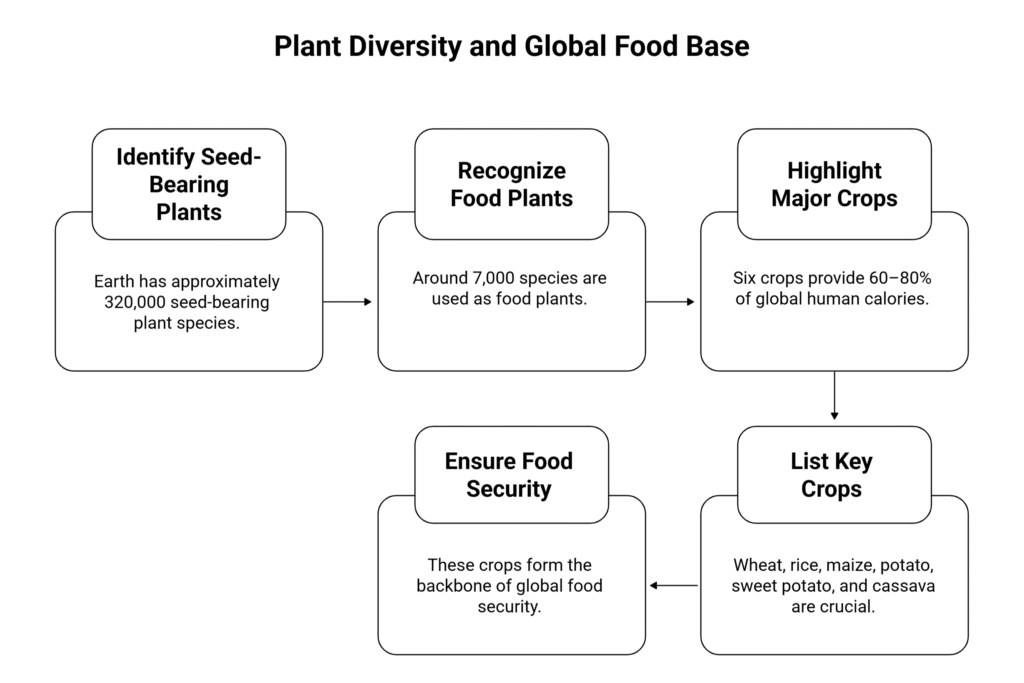
- Earth has ~320,000 seed-bearing plant species.
- ~7,000 species are used as food plants.
- Six crops provide 60–80% of global human calories:
- Wheat
- Rice
- Maize (corn)
- Potato
- Sweet potato
- Cassava
These crops form the backbone of global food security.
History of Plant Breeding
Early Domestication
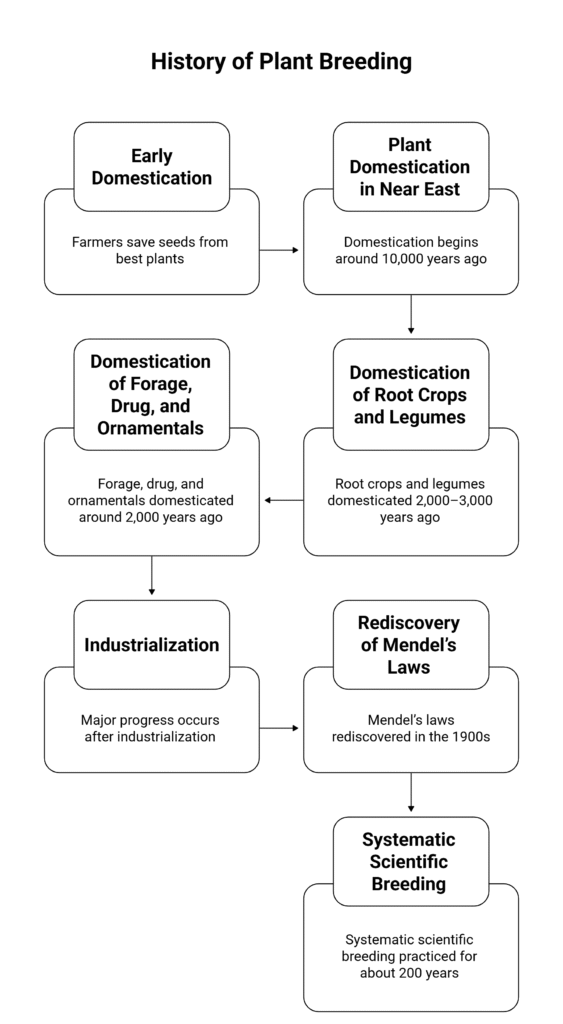
- Began with early farmers saving seeds of their best plants.
- Plant domestication started ~10,000 years ago in the Near East.
- Root crops and legumes: domesticated 2,000–3,000 years ago.
- Forage, drug, and ornamentals: domesticated ~2,000 years ago.
Scientific Breeding
- Major progress occurred after:
- Industrialization
- Rediscovery of Mendel’s laws (1900s)
- Systematic scientific breeding has been practiced for only ~200 years.
Genotype × Environment Interaction (G × E)
Plant performance depends on:
- Genetics (Genotype)
- Climate & soil (Environment)
- Their combined interaction (G × E)
Example: Wheat varieties respond differently to fertilizers depending on their genotype.
Case Study: Breeding of Sugar Beet (Beta vulgaris)
- 4000 BC: Sugar cane cultivation in India.
- 800 AD: Sugar cane grown in Italy and Spain.
- 18th century: Shortage of sugar stimulated alternative sources.
- 1747: Andreas Marggraf discovered sugar in fodder beet.
- 1786: Archard began selecting beets with high sugar content.
- 1802: First sugar beet refinery established in Germany.
- 1952: Discovery of the monogerm gene (single-seeded fruits).
Centers of Origin & Domestication (Vavilov’s Concept)
Definition
Regions where early humans first domesticated plants and where:
- Genetic diversity is highest,
- Wild relatives of crops are abundant,
- Agriculture has ancient roots.
Importance of Centers of Origin
These regions are vital for:
- Crop improvement
- Breeding for resistance
- Climate resilience
- Germplasm conservation (gene banks, field banks, in-situ conservation)
Major Centers of Domestication & Their Crops
North American Region
Crops:
- Sunflower
- Maize
- Cotton
- Tomato
- Zinnia
- Marigold
Notes:
- Maize domesticated from teosinte in Mexico.
- Sunflower—major global oilseed.
- Cotton (G. hirsutum) originated here.
Mesoamerican / Central American Region
Crops
- Maize
- Beans
- Chili peppers
- Squash
- Tomato
- Cotton
Notes
- Richest center for vegetable crops.
- Valuable genes for disease resistance.
South American (Andes–Amazon) Region
Crops
- Potato
- Cassava
- Peanut
- Sweet potato
- Coca
- Minor tubers (oca, ulluco)
Notes
- Potato became a global staple.
- Cassava critical for tropical food security.
European / Mediterranean Region
Crops
- Wheat
- Barley
- Oats
- Apple
- Grapes
- Olives
- Fodder crops
Notes
- Early cereal domestication.
- Major fruit and oil crops.
Near Eastern (Fertile Crescent) Region
Crops
- Wheat (emmer, einkorn)
- Barley
- Lentil
- Pea
- Chickpea
- Flax
Notes:
- First settled agriculture ~10,000 years ago.
- Birthplace of cereal and pulse domestication.
Central Asian Region
Crops
- Wild apples
- Grapes
- Onion
- Carrot
Notes
- Extremely rich fruit diversity.
- Important for improving apple cultivars.
Chinese Region
Crops
- Rice (Oryza sativa)
- Soybean
- Peach
- Apricot
- Citrus
- Tea
Notes
- One of world’s oldest agricultural centers.
- Rice domesticated ~10,000 years ago.
Indo-Malayan / Southeast Asian Region
Crops
- Banana
- Sugarcane
- Coconut
- Taro
- Black pepper
- Turmeric
- Citrus spp.
Notes
- Center of tropical fruits and spices.
- Sugarcane and banana originated here.
African Centers
A. Ethiopian Highlands
Crops
- Coffee
- Finger millet
- Teff
- Castor
- Chickpea (secondary center)
B. West African Region
Crops
- Sorghum
- Oil palm
- Yam
- Cowpea
- Watermelon (wild type)
Notes:
- Known for drought-tolerant crops.
Summary Table of Crop Domestication
| Region | Key Crops |
| North America | Sunflower, maize, cotton, tomato |
| Central America | Beans, chili, squash |
| South America | Potato, cassava, peanut |
| Mediterranean/Europe | Wheat, barley, apple |
| Near East | Wheat, barley, lentil, pea |
| Central Asia | Apple, grapes, onion |
| China | Rice, soybean, peach |
| Indo-Malayan | Banana, sugarcane, coconut |
| Africa | Sorghum, coffee, finger millet |
Importance of Domestication Centers in Modern Breeding
A. Genetic Diversity
Provides raw material for:
- Disease resistance
- Drought and heat tolerance
- Pest resistance
- Nutritional enhancement
B. Germplasm Conservation
Preserved through:
- Gene banks
- Field gene banks
- In situ conservation
C. Crop Improvement
Used for:
- Hybrid breeding
- Backcrossing
- Mutation breeding
- Genome editing (CRISPR)
D. Climate Change Adaptation
Wild genes help breed:
- Drought-resistant wheat
- Heat-tolerant maize
- Flood-tolerant rice (e.g., SUB1 gene)
- Insect- and disease-resistant cultivars
Strategy of Plant Breeding
Plant breeding is a systematic, scientific process aimed at developing superior crop varieties with improved yield, stress tolerance, and adaptability. The strategy typically follows four key steps:
Identification of Useful Traits
The first step in plant breeding is to identify traits that can improve the performance or usefulness of a crop. These may be:
I. Morphological Traits
These are visible and structural features of the plant.
Examples:
- Plant height
- Leaf size and shape
- Seed size and color
- Number of tillers
- Root architecture
- Days to maturity
Importance
Morphological traits help in improving crop architecture, harvesting efficiency, and consumer preference.
II. Physiological Traits
Traits related to internal biological processes.
Examples:
- Photosynthetic efficiency
- Water-use efficiency
- Nitrogen-use efficiency
- Drought tolerance mechanisms
- Salt and heat tolerance
Importance
Physiological traits contribute to stress resistance and productivity under variable climate conditions.
III. Pathological Traits
Traits related to plant resistance or susceptibility to diseases and pests.
Examples:
- Resistance to fungal diseases (rust, blight, mildew)
- Resistance to viral diseases (mosaic virus, leaf curl)
- Resistance to insects (stem borer, aphids)
Importance
These traits protect yield and reduce reliance on chemical pesticides.
IV. Sources of Useful Traits
Breeders explore traits using:
- Wild relatives (rich in resistance genes)
- Landraces (locally adapted accessions)
- Mutants
- Existing improved varieties
- Germplasm banks
Identification of Genes/Loci Responsible
After identifying a useful trait, the next step is to determine the genetic basis behind it.
I. Gene Mapping
Using tools like:
- Linkage mapping
- QTL (Quantitative Trait Loci) analysis
- GWAS (Genome-Wide Association Studies)
II. Molecular Marker Techniques
- RFLP
- RAPD
- SSR
- SNP markers
Uses
Markers linked to desirable traits help in faster selection through marker-assisted selection (MAS).
III. Identifying Gene Function
Through:
- Gene expression studies
- Knock-out mutants
- Functional genomics
- CRISPR gene editing
Importance:
Knowledge of gene location and function allows more precise breeding and biotechnology-based improvements.
Combining Genes into an Improved Cultivar
Once genes are identified, breeders combine them into a single genotype through:
I. Hybridization
Crossing genetically diverse parents to combine desirable traits.
Example:
- Disease-resistant parent × High-yielding parent
Outcome: Hybrid population with combined traits.
II. Selection
Choosing individuals superior for desired traits.
Methods include:
- Mass selection
- Pedigree selection
- Bulk selection
- Recurrent selection
- Marker-assisted selection (MAS)
III. Backcross Breeding
Used to transfer a specific gene (e.g., disease resistance) into an elite variety.
IV. Mutation Breeding
Using radiation or chemicals to create beneficial mutations.
Example: Improved rice varieties (e.g., Sharbati Sonora).
V. Biotechnology-Based Approaches
- Genetic engineering (GM crops)
- CRISPR/Cas genome editing
- Tissue culture and micropropagation
- Doubled haploids (to fix traits quickly)
Goal
To assemble all desirable genes in a stable, uniform, high-performing cultivar.
Evaluation of Performance Across Multiple Environments
After developing potential new varieties, breeders test them under diverse conditions.
I. Multi-location Trials
Conducted across:
- Different agro-climatic zones
- Varied soil types
- Different seasons
II. Parameters Evaluated
- Yield
- Disease/pest resistance
- Stress tolerance (drought, salinity, heat)
- Quality traits (protein, sugar content, fiber quality)
- Maturity duration
III. Genotype × Environment (G × E) Interaction
Varieties may perform differently in different environments.
Example:
A variety performing well under high soil fertility may not yield well in low-input conditions.
IV. Stability Analysis
Breeders use statistical models to identify stable and high-performing genotypes across environments.
V. Official Testing
Before release, varieties undergo:
- Pre-release trials
- National performance trials
- Distinctness, Uniformity, Stability (DUS) testing
Outcome
Only the best-performing, stable, and superior lines are released as new varieties.
Multiple Choice Questions (MCQs)
Q1. Which of the following crops is NOT one of the six crops providing 60–80% of global calories?
A. Wheat
B. Potato
C. Cassava
D. Sorghum
Answer: D. Sorghum
Q2. Plant breeding is best defined as:
A. Natural evolution of crops
B. Evolution guided by humans through selection
C. Mutation of wild plants
D. Hybridization of animals
Answer: B. Evolution guided by humans through selection
Q3. Which scientist first proposed Centers of Origin of cultivated plants?
A. Charles Darwin
B. Gregor Mendel
C. Nikolai Vavilov
D. Norman Borlaug
Answer: C. Nikolai Vavilov
Q4. The earliest region where settled agriculture began (~10,000 years ago) is:
A. Ethiopian Highlands
B. Fertile Crescent (Near East)
C. Andes Mountains
D. East Asia
Answer: B. Fertile Crescent (Near East)
Q5. Maize was domesticated from which wild grass?
A. Triticum
B. Teosinte
C. Hordeum
D. Oryza nivara
Answer: B. Teosinte
Q6. Which center is known for the domestication of rice, soybean, and tea?
A. Central Asia
B. China
C. Indo-Malayan region
D. Mediterranean
Answer: B. China
Q7. Which crop originated in the Ethiopian Highlands?
A. Cassava
B. Coffee
C. Banana
D. Sorghum
Answer: B. Coffee
Q8. Which of the following crops originated in South America (Andes region)?
A. Sorghum
B. Wheat
C. Potato
D. Finger millet
Answer: C. Potato
Q9. Which factor contributed 30–50% to yield improvement between 1920–1980?
A. Irrigation
B. Chemical fertilizers
C. Plant breeding
D. Mechanization
Answer: C. Plant breeding
Q10. Sugar beet improvement began after the discovery of sugar in fodder beet by:
A. Archard
B. Vavilov
C. Marggraf
D. Darwin
Answer: C. Marggraf
Q11. Monogerm sugar beet seeds are beneficial because:
A. They contain more sugar
B. They allow easier mechanical sowing
C. They resist pests better
D. They have deeper roots
Answer: B. Easier mechanical sowing
Q12. The Indo-Malayan region is known as the center for which major crops?
A. Wheat and barley
B. Banana and sugarcane
C. Grapes and apple
D. Soybean and tea
Answer: B. Banana and sugarcane
Q13. The concept of Genotype × Environment interaction means:
A. Environment has no effect on yield
B. All varieties give same yield everywhere
C. A genotype performs differently across environments
D. Genes remain stable in all environments
Answer: C. A genotype performs differently across environments
Q14. The primary goal of plant-breeding programs is:
A. Bigger leaves
B. Higher yield
C. Taller plants
D. Faster flowering
Answer: B. Higher yield
Q15. Which region contributed the highest diversity of fruit crops like apple and grapes?
A. Central Asia
B. Mediterranean
C. China
D. North America
Answer: A. Central Asia
Q16. Cassava originated in which domestication center?
A. Africa
B. South America
C. Mesoamerica
D. Near East
Answer: B. South America
Q17. Which crop originated in West Africa?
A. Yam
B. Wheat
C. Potato
D. Soybean
Answer: A. Yam
Q18. Vavilov’s centers are important for plant breeding because they provide:
A. Uniform crop varieties
B. Maximum genetic diversity
C. High-yielding hybrids only
D. Modern varieties
Answer: B. Maximum genetic diversity
Q19. Which of the following is NOT a major crop from the Near East?
A. Lentil
B. Wheat
C. Barley
D. Peanut
Answer: D. Peanut
Q20. Which crop originated in North America?
A. Sunflower
B. Coffee
C. Tea
D. Sorghum
Answer: A. Sunflower
References
- Brooker R.J. (2005). Genetics: Analysis and Principles.
- Griffiths et al. (2015). Genetic Analysis.
- Pierce B. (2014). Genetics: A Conceptual Approach.
- Russell P.J. (2010). iGenetics: A Molecular Approach.