Mustard Aphid
The mustard aphid (Lipaphis erysimi) is a significant sucking pest that poses a serious threat to mustard crops, often causing substantial yield losses if not properly managed. Effective management strategies are crucial to protect crop health, ensure optimal growth, and maintain both seed yield and oil quality.
Systematic Position
- Kingdom: Animalia
- Phylum: Arthropoda
- Class: Insecta
- Order: Hemiptera
- Suborder: Sternorrhyncha
- Family: Aphididae
- Genus: Lipaphis
- Species: erysimi
Common Names: Mustard aphid, Turnip aphid, Rape aphid, Cabbage aphid.
Distribution
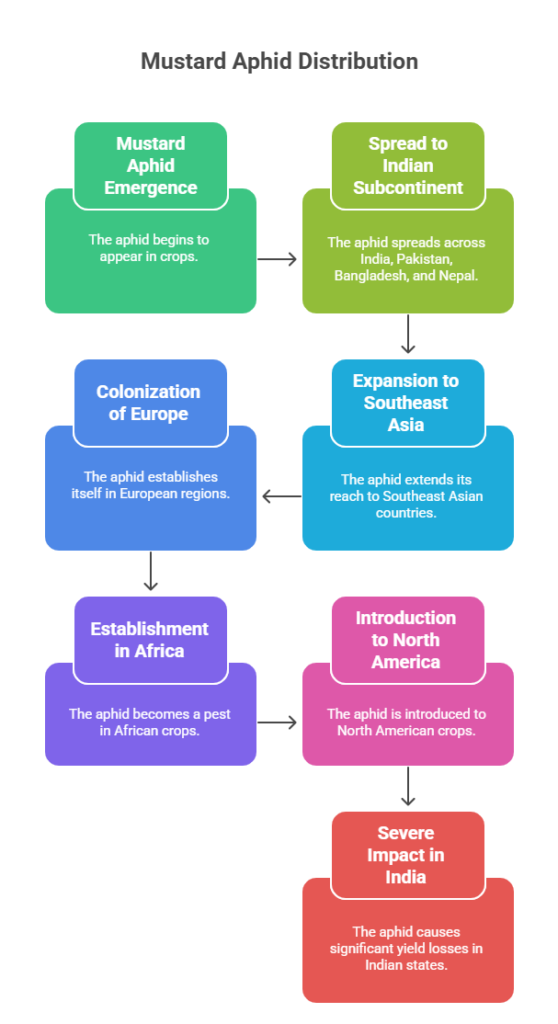
Mustard aphid is a major pest of cruciferous crops worldwide. It is particularly severe in the Indian subcontinent (India, Pakistan, Bangladesh, Nepal), Southeast Asia, Europe, Africa, and North America. In India, it is the most destructive pest of rapeseed-mustard, causing significant yield losses in states like Rajasthan, Uttar Pradesh, Haryana, Punjab, Madhya Pradesh, West Bengal, and Gujarat.
Host Plants
Primary Hosts
The primary hosts are cruciferous crops belonging to the family Brassicaceae, which include both oilseed and vegetable crops of major agricultural importance. Among the oilseed hosts, mustard (Brassica juncea), rapeseed (Brassica napus), toria (Brassica rapa), and Indian mustard are highly susceptible and commonly attacked.
In addition, several cruciferous vegetables such as cabbage, cauliflower, broccoli, radish, turnip, and knol-khol also serve as important primary hosts, providing favorable conditions for pest survival, multiplication, and spread. The wide host range within this family enables the pest to persist throughout the cropping season and across different production systems.
Secondary/Alternate Hosts
In addition to its primary hosts, the pest also utilizes several secondary or alternate hosts, which play a crucial role in its survival during unfavorable periods. It can feed on crops such as beetroot and spinach, as well as on a variety of weed species, particularly during the off-season when cruciferous crops are not available.
These alternate hosts act as reservoirs, allowing the pest population to persist, bridge crop-free periods, and later migrate back to primary hosts when favorable conditions and suitable crops return, thereby increasing the risk of early-season infestation.
Pest Identification
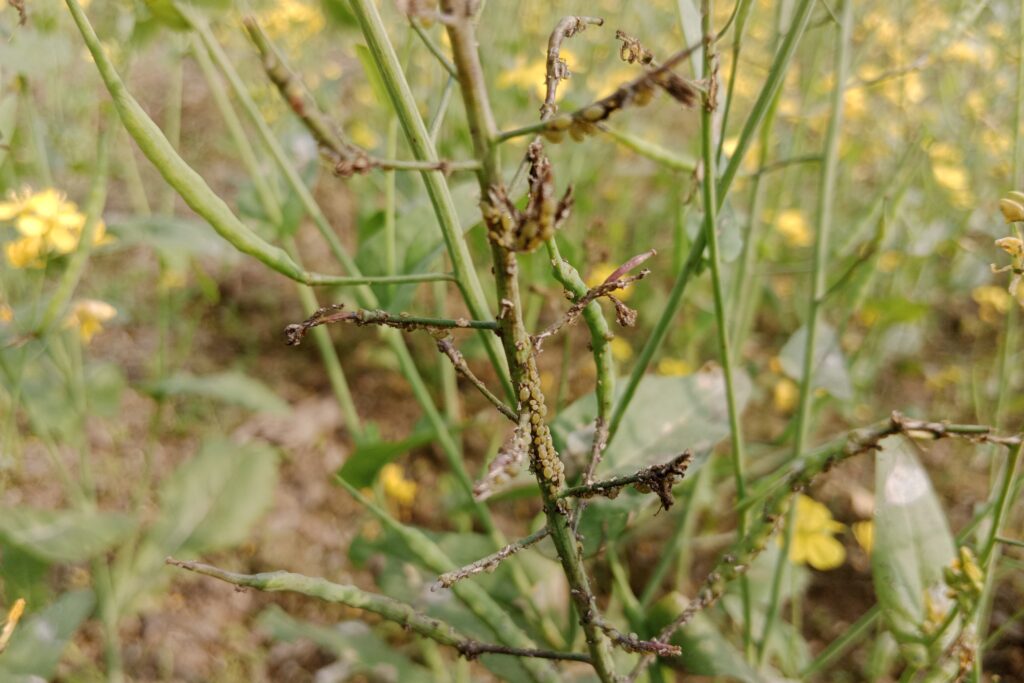
Identification of the pest is based on its distinct morphological features observed in both nymphs and adults, which are soft-bodied, small insects measuring about 1.5–2.5 mm in length. They are typically yellowish-green to greyish-green in color and are often covered with a whitish, waxy powder that gives them a dull appearance.
The body is pear-shaped and characterized by the presence of a pair of cornicles (siphunculi) at the posterior end of the abdomen, which are short, slightly swollen, and darker in color. Under conditions of overcrowding or during seasonal migration, winged forms (alates) are produced; these adults possess a darker head and thorax along with transparent wings, enabling them to disperse and colonize new host plants.
Symptoms / Nature of damage
The pest feeds on plants using its piercing-sucking mouthparts, targeting leaves, stems, buds, and especially the flowers and pods. Both nymphs and adults are phloem feeders, extracting sap and thereby weakening the host plant.
Sap extraction leads to stunted growth, curling of leaves, and poor pod development. Infestations during the pod formation stage are particularly critical, as they directly reduce seed filling and overall yield.
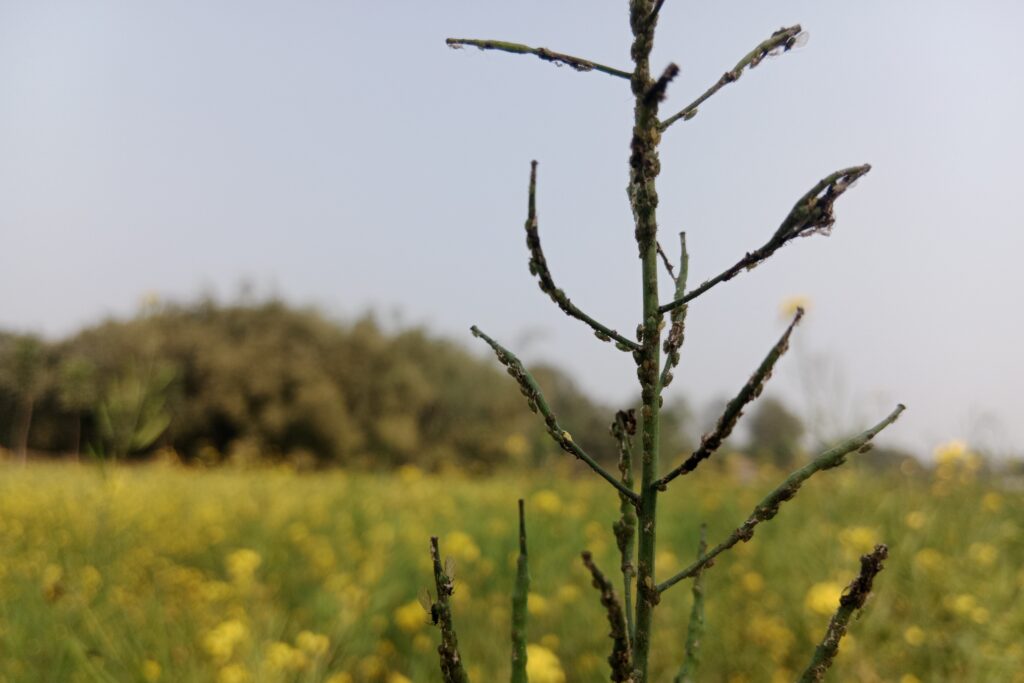
Aphids produce a sticky, sugary substance called honeydew, which encourages the growth of sooty mold on leaves, reducing photosynthesis. Additionally, they act as vectors for plant viruses, such as Turnip mosaic virus (TuMV), further affecting plant health.
The damage caused by these pests can result in yield reductions of 35% to 75%, and in severe infestations, losses may reach up to 90%. Both seed yield and oil content are affected, and the quality of the oil is also compromised.
Life Cycle & Seasonal History
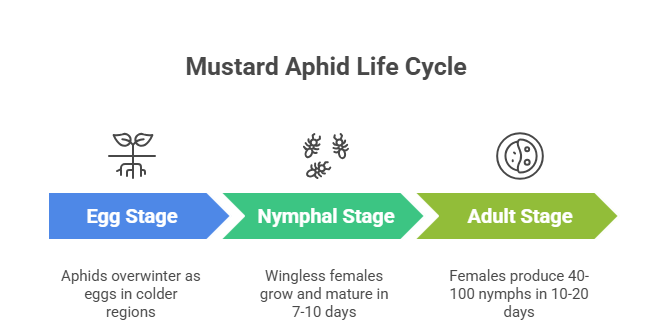
The mustard aphid exhibits a rapid and prolific reproductive cycle, primarily reproducing through parthenogenesis (virgin birth) during the crop season, which enables rapid population build-up and sudden outbreaks under favorable conditions.
Egg Stage
In colder regions, the aphids overwinter in the egg stage, laying eggs on host plants or surrounding weeds, which serve as reservoirs for the next growing season.
Nymphal Stage
Upon hatching, the nymphal stage begins, during which the wingless viviparous females grow and mature within 7–10 days, undergoing four molts before reaching adulthood.
Adult Stage
The adult stage is highly productive, as a single female can produce 40–100 nymphs over a lifespan of 10–20 days, contributing to exponential population growth and posing a significant threat to cruciferous crops throughout the season.
Population Dynamics in India
In India, mustard aphid infestation typically begins in the last week of December or early January, when crops are transitioning from the vegetative to flowering stage. The population reaches its peak during February to March, coinciding with the pod formation stage, when temperatures range from 20–25°C and humidity is moderate, creating ideal conditions for rapid multiplication.
With the onset of hot summer temperatures above 30°C in late March to April, the aphid population declines significantly. During the off-season, including the summer and rainy periods, the pest persists by surviving on collateral hosts and weed plants, allowing it to re-infest crops in the subsequent season.
Management
Cultural Control
- Early Sowing: Sow mustard early (October) to escape peak aphid infestation during pod formation.
- Clean Cultivation: Remove and destroy crop residues and alternate weed hosts.
- Balanced Fertilizer: Avoid excessive nitrogen, which promotes succulent growth favorable to aphids.
- Intercropping: Intercrop mustard with wheat, barley, or coriander to reduce aphid colonization.
- Irrigation: A light overhead irrigation can dislodge a significant number of aphids.
Mechanical Control
- Use yellow sticky traps to monitor and trap alate (winged) aphids.
- Rogue out and destroy severely infested plants initially.
Biological Control
Biological control of mustard aphid relies on conserving its natural enemies, which include a range of predators, parasitoids, and entomopathogenic fungi. Key predators are ladybird beetles (Coccinella septempunctata), green lacewings (Chrysoperla carnea), and syrphid fly larvae, while important parasitoids include the braconid wasp (Diaeretiella rapae).
Additionally, entomopathogenic fungi such as Lecanicillium lecanii and Beauveria bassiana play a vital role in suppressing aphid populations. To ensure the effectiveness of these biological control agents, it is crucial to avoid indiscriminate use of broad-spectrum insecticides, which can harm beneficial organisms and disrupt natural pest regulation.
Chemical Control
Chemical control of mustard aphid should be used only as a last resort, and sprays are recommended only when the economic threshold level (ETL) is exceeded, which is defined as 50–100 aphids per 10 cm of shoot tip or 20% of plants showing infestation. For effective management, systemic insecticides are preferred to ensure thorough control of the pest throughout the plant.
Recommended insecticides include neonicotinoids such as Imidacloprid 17.8 SL (@ 0.3 ml/liter) and Thiamethoxam 25 WG (@ 0.2 g/liter), as well as other options like Acetamiprid 20 SP (@ 0.2 g/liter), Flonicamid 50 WG (@ 0.3 g/liter), and Spirotetramat 15.31 OD (@ 1 ml/liter). During periods of low infestation, insecticidal soaps or oils, including mineral oil or neem-based products (azadirachtin 0.03% or neem oil 2%), can be effective. To prevent resistance development, it is important to rotate insecticides with different modes of action and strictly follow local guidelines and pre-harvest intervals.
ALSO READ: MUSTARD FARMING PROFIT PER ACRE
FAQs
Q1. Can I spray aphids with vinegar?
Spraying aphids with vinegar is not recommended as a standard pest control method. While vinegar is acidic and may kill some soft-bodied insects on contact, it can also damage or burn the plant leaves and stems, reducing plant health and productivity. Additionally, vinegar is not selective and does not provide residual control, so aphid populations can quickly rebound.
For effective and safe aphid management, it is better to rely on biological control, insecticidal soaps, neem oil, or approved systemic insecticides, following recommended doses and application guidelines to protect both the plants and beneficial insects.
Q2. Is there a systemic insecticide for aphids?
Yes, there are systemic insecticides available for controlling aphids. These insecticides, such as Imidacloprid, Thiamethoxam, Acetamiprid, and Spirotetramat, are absorbed by the plant and transported through its tissues, effectively targeting aphids that feed on leaves, stems, and sap. Systemic insecticides provide longer-lasting control compared to contact sprays, but should be used judiciously, following recommended doses, pre-harvest intervals, and rotation practices to prevent resistance and protect beneficial insects.
Q3. What is the best homemade aphid killer?
One of the most effective homemade aphid killers is a simple soap and water spray. Mix 1–2 teaspoons of mild liquid soap (like castile or dish soap without harsh additives) in 1 liter of water and spray directly on the aphids, covering leaves, stems, and undersides where they hide. The soap disrupts the aphids’ protective outer layer, causing dehydration and death, but is safe for plants when used in the correct concentration.
Adding a few drops of neem oil can enhance effectiveness and also act as a repellent, while being gentle on beneficial insects like ladybugs and lacewings. Avoid using harsh soaps or undiluted vinegar, as these can damage the plants.
Sources
Atwal, A.S. 1993. Agricultural Pests of India and South-East Asia. Kalyani Publishers, New Delhi.
Neupane, F.P. 2000. Bali Biruwa Ka Satruharu Ra Tinka Roktham (in Nepali). 4th edition. Sajha Prakasan.
Panwar,V.P.S. 1995. Agricultural Insect Pests of Crops and their Control. Kalyani Publishers, New Delhi.
Tamil Nadu Agriculture University (TNAU) – Agritech portal
Indian Council of Agricultural Research (ICAR)
Nepal Agricultural Research Council (NARC)