Sesame Powdery Mildew
Sesame Powdery Mildew Management is a critical aspect of successful sesame cultivation, as powdery mildew is a major fungal disease that can severely impact plant health, reduce seed yield, and lower oil content if left unmanaged. This disease typically develops during the later growth stages of the crop, particularly under favorable environmental conditions such as moderate temperatures, high humidity, and dense crop canopies.
Effective sesame powdery mildew management involves a combination of cultural practices, resistant varieties, balanced fertilization, careful irrigation, biological control, and, when necessary, targeted chemical treatments. Implementing these strategies in an integrated manner helps protect crop vigor, ensure healthy seed development, and maintain high-quality sesame oil production.
Causes
Sesame powdery mildew is caused by the fungus Oidium sesami (sometimes reported as Erysiphe spp.).
It is an obligate parasite, meaning it can survive and multiply only on living plant tissue. The fungus primarily infects the leaves, but under severe conditions it can also spread to the stems, flowers, and capsules. It produces characteristic powdery white spores (conidia) on the plant surface, which are easily dispersed by wind, leading to rapid spread of the disease.
Symptoms
Symptoms usually appear after flowering but can occur earlier under favorable conditions.
Early Symptoms
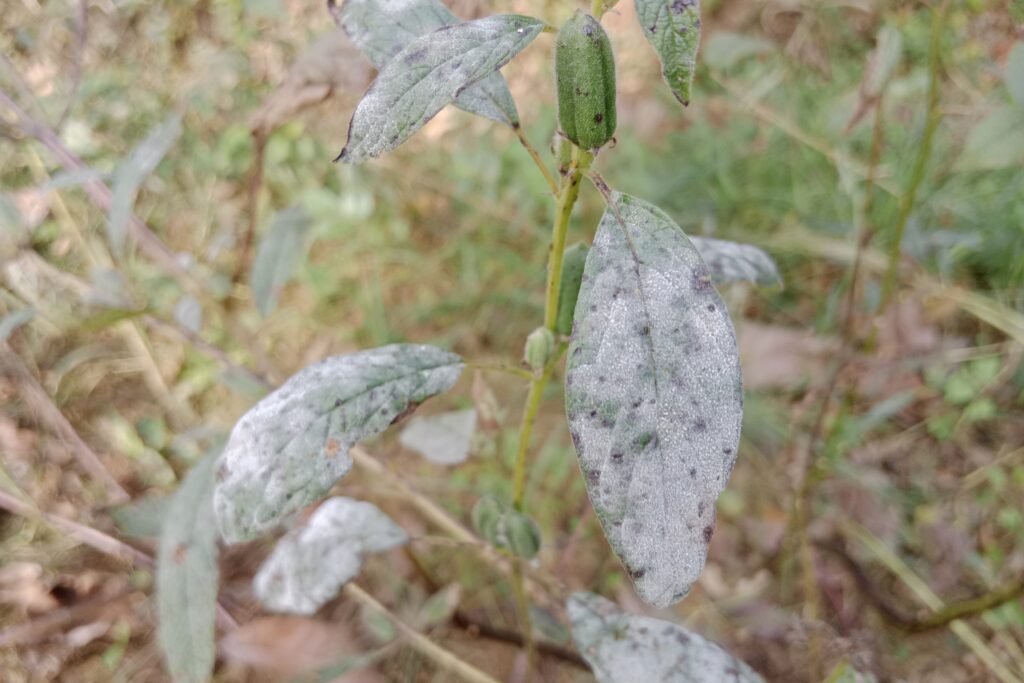
In the early stage of the disease, small white to greyish powdery spots begin to appear on the upper surface of the leaves. These spots look like fine dust or flour sprinkled over the leaf surface and are usually the first visible sign of infection. As the disease establishes, the powdery growth gradually increases in size and number, indicating active fungal development and signaling the need for timely management to prevent further spread.
Advanced Symptoms
As the disease progresses to an advanced stage, the powdery patches spread rapidly and may cover the entire leaf surface, severely affecting photosynthesis. Infected leaves gradually turn yellow, then brown, and eventually dry up and fall off prematurely. Under severe infection, the fungus can also spread to stems, flowers, and capsules, leading to poor capsule development and the formation of shrivelled, low-quality seeds. As a result, the overall plant becomes weak and stunted, ultimately causing significant yield and quality losses in sesame.
Epidemiology
Epidemiology describes how environmental factors affect the development and spread of sesame powdery mildew. The disease develops rapidly under moderate temperatures ranging from 20–30°C and high relative humidity of about 60–80%, especially during dry weather conditions accompanied by cool nights.
Dense crop canopies with poor air circulation further favor disease buildup, while excessive application of nitrogen fertilizers promotes soft, succulent plant growth that is more susceptible to infection. Unlike many other fungal diseases, powdery mildew does not require free water such as rain or dew for infection, which makes it particularly common during dry seasons with humid air conditions.
Disease Cycle
The disease cycle of sesame powdery mildew begins with the fungus surviving on infected plant debris or volunteer sesame plants. When environmental conditions become favorable, the pathogen produces airborne conidia that are easily dispersed by wind to nearby healthy plants. These spores germinate on the leaf surface and penetrate the plant tissue using specialized structures called haustoria.
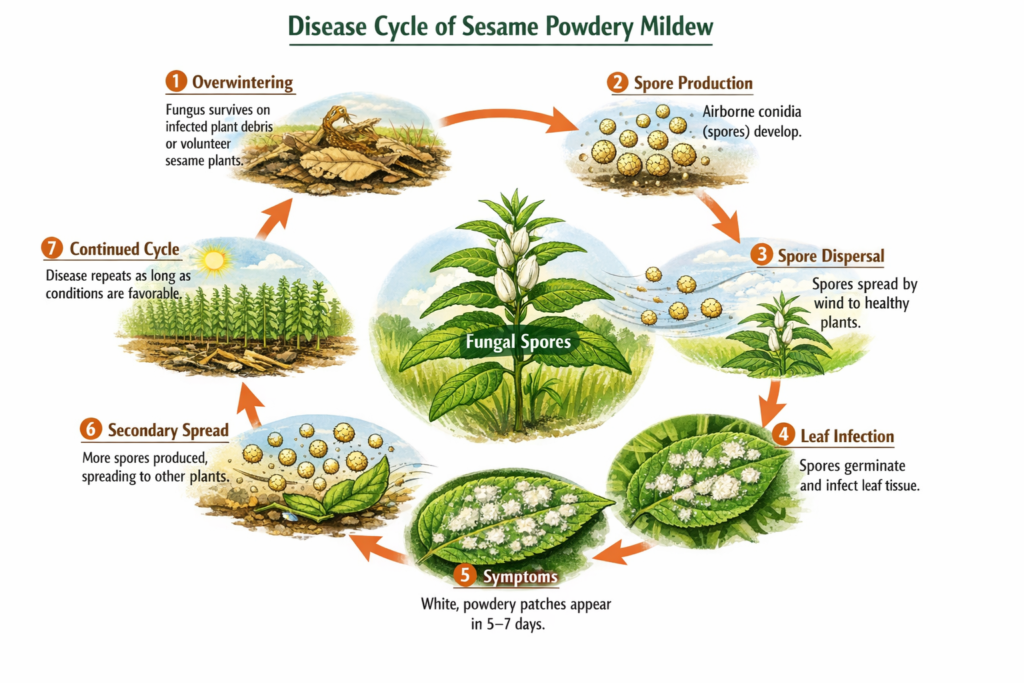
Within about 5–7 days, new fungal growth becomes visible as characteristic powdery white patches on the leaves. The fungus then produces more spores, causing rapid secondary spread across the field, and the disease cycle continues repeatedly as long as favorable conditions persist.
Sesame Powdery Mildew Management
Successful control of powdery mildew in sesame depends on adopting an Integrated Disease Management (IDM) strategy that combines preventive and curative measures.
Cultural Practices
- Use only healthy, certified, and disease-free seeds for sowing.
- Maintain recommended plant spacing to allow proper air movement within the crop canopy.
- Avoid overuse of nitrogen fertilizers; instead, apply nutrients in a balanced manner.
- After harvest, collect and destroy infected plant residues to eliminate sources of infection.
- Practice crop rotation with non-host crops to break the disease cycle.
Resistant Varieties
Cultivating sesame varieties that show tolerance or resistance to powdery mildew is one of the most effective and economical methods of disease control. Farmers are encouraged to select locally adapted resistant varieties to minimize disease pressure and reduce yield losses.
Biological Control
Eco-friendly management of powdery mildew can be achieved through biological and botanical options. Application of wettable sulfur at 0.2% concentration helps suppress fungal growth. Beneficial microorganisms such as Trichoderma viride and Pseudomonas fluorescens can also be used to reduce pathogen activity and enhance the plant’s natural defense system. Neem-based products provide additional support by limiting disease spread while promoting sustainable crop protection.
Chemical Control (in Severe Conditions)
When the disease reaches severe levels and cannot be controlled effectively through cultural and biological measures alone, fungicide application becomes necessary. Recommended fungicides include Sulfur 80 WP (2 g per liter of water), Hexaconazole 5 EC (1 ml per liter), or Propiconazole 25 EC (1 ml per liter). Spraying should begin immediately upon the first appearance of symptoms.
If disease pressure continues, a second spray may be applied after 10–15 days. To avoid the development of fungicide resistance, products with different modes of action should be rotated, and all applications must strictly follow label recommendations and safety precautions.
Frequently Asked Questions (FAQs)
Q1. When should fungicides be applied for powdery mildew?
Fungicide application should begin as soon as the first signs of powdery mildew appear, typically observed as small white or light gray powdery patches on the leaves. For best results, spraying should be done during the early morning or late afternoon to reduce evaporation and minimize the risk of leaf damage. Early intervention helps restrict the spread of the fungus to other plant parts. If the infection persists, a second application after 10–15 days is advised. Rotating fungicides with different modes of action and adhering to recommended dosages are essential to prevent resistance.
Q2. What systemic fungicides are effective against powdery mildew?
Systemic fungicides are absorbed by the plant and move internally to control the fungus from within. Commonly used systemic fungicides for sesame powdery mildew include Hexaconazole 5 EC and Propiconazole 25 EC, each applied at 1 ml per liter of water. The initial spray should be applied at the onset of symptoms, followed by a repeat spray after 10–15 days if required. Alternating systemic fungicides with contact fungicides such as wettable sulfur helps maintain effectiveness and delays resistance development.
Q3. What is the main cause of powdery mildew?
Powdery mildew in sesame is caused by the fungus Oidium sesami, but its severity is greatly influenced by environmental and crop management factors. Continuous cultivation of sesame without rotation allows the pathogen to survive on plant residues and volunteer plants. Dense crop growth creates a humid microenvironment favorable for infection. Moderate temperatures (20–30°C), high humidity (60–80%), dry weather, and cool nights further encourage disease development. Excessive nitrogen fertilization and improper irrigation practices that increase canopy humidity also increase susceptibility.
Q4. Is it possible to permanently eliminate powdery mildew?
Completely eradicating powdery mildew is difficult because the pathogen can persist on crop residues and volunteer plants. However, its impact can be significantly reduced through consistent integrated management. This includes planting resistant varieties, rotating crops, maintaining proper spacing, and practicing good field sanitation. Balanced nutrient management and controlled irrigation help reduce favorable conditions for the disease. Biological agents and neem-based products provide natural suppression, while timely application of systemic fungicides at early stages ensures effective control. Combining these approaches offers long-term disease management and protects crop yield and quality.
Q5. During which period is powdery mildew most severe?
Powdery mildew is most severe during periods when moderate temperatures (20–30°C) coincide with high humidity levels (60–80%). In sesame, the disease is commonly observed during the later growth stages, particularly after flowering. Dry weather with cool nights and dense crop canopies further enhance disease development. Although free moisture is not required for infection, these conditions create an ideal environment for fungal growth and rapid spread.