Rainbow Trout Farming
Rainbow trout (Oncorhynchus mykiss) is a cold-water fish highly valued for its taste, nutrition, and market demand. In Nepal, rainbow trout farming is concentrated in hilly and mountainous regions with access to cold, oxygen-rich water, such as Syangja, Kaski, Lamjung, and Mustang. Trout farming provides a lucrative income source for farmers due to high market prices, short production cycles (6–8 months), and growing domestic and export demand.
Rainbow trout farming profit in Nepal has proven to be a highly lucrative venture, especially for small-scale farmers managing 0.1-hectare (1,012 m²) farms. With a one-time capital investment of NPR 400,000 and annual operating costs of NPR 345,000, the total expenditure amounts to NPR 745,000. Against a total revenue of NPR 1,400,000, this results in a gross profit of NPR 1,055,000 and a net profit of NPR 655,000, yielding a return on investment (ROI) of approximately 87.9%, highlighting the significant earning potential and attractiveness of rainbow trout farming in Nepal.

Farm Size and Production System
Rainbow trout farms in Nepal typically range from 0.05 to 0.5 hectares for small-scale farmers, while commercial operations may extend to 1 hectare or more, utilizing production systems such as flow-through raceways, where water continuously flows from upstream sources to ensure proper oxygenation and waste removal; pond-cum-raceway systems, which combine pond storage with controlled flow-through for improved management; and, less commonly, cages in rivers or reservoirs due to regulatory and water flow limitations, with most farms operating on a semi-intensive basis that relies on supplemental feeding and careful water quality management.
Pond Construction
Trout ponds require careful construction, typically designed in rectangular or raceway-style shapes to ensure proper water circulation, with a depth of 1–1.5 meters to maintain stable temperatures, using cold (10–18°C), oxygen-rich water sources; common materials in Nepal include concrete, brick, or stone-lined ponds, while properly lined earthen ponds are used in rural areas, and proper inflow and outflow channels are essential to prevent water stagnation.
Pond Preparation
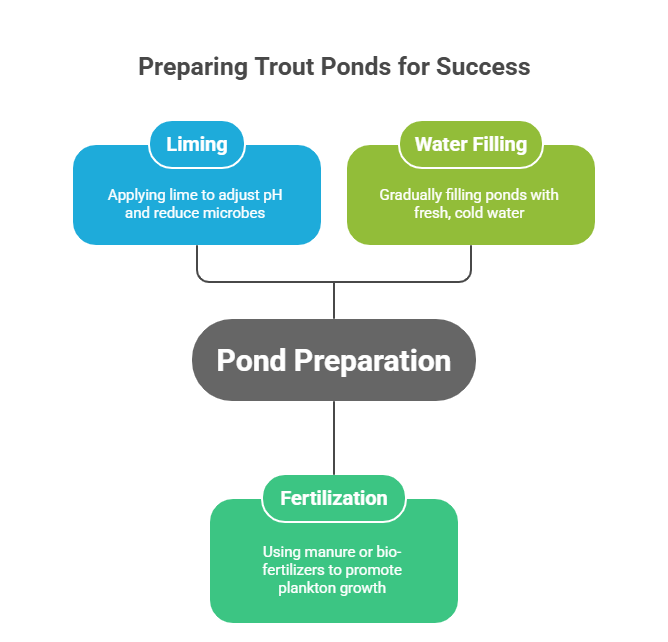
Before stocking, trout ponds must be carefully prepared to ensure healthy fish growth, beginning with liming, where 50–100 kg of agricultural lime (CaCO₃) per 100 m² is applied to adjust the pH and reduce harmful microbes, followed by fertilization using organic manure or bio-fertilizers to promote plankton growth that supplements the diet of young fry, and finally, the ponds are gradually filled with fresh, cold water while ensuring that no contamination enters from upstream sources, creating an optimal environment for the fish to thrive.
Seed Selection
Healthy fry or fingerlings are critical for successful rainbow trout farming, so it is essential to select individuals of uniform size, typically 3–5 grams, that exhibit active swimming behavior, indicating vitality and good health; these fry should be sourced from certified hatcheries to ensure quality and disease-free stock, while weak, deformed, or disease-affected fry must be avoided, as their introduction can reduce survival rates, hinder growth, and increase the risk of spreading diseases in the pond.
Feeding
Rainbow trout require high-protein diets to support healthy growth and optimal production, with juveniles needing 35–45% protein and adults requiring 28–35%, and feeding is typically done using commercial pellets, which are preferred for their balanced nutrition, although locally prepared feeds made from soybean, rice bran, and fish meal can also be used; fish should be fed 3–5 times daily, with the amount and frequency adjusted according to water temperature and the appetite of the fish to ensure efficient feed utilization and minimize waste.
Water Quality Management
Water quality management is critical for rainbow trout farming, as cold, oxygen-rich water is essential for healthy growth and survival, with optimal temperatures ranging from 10–18°C and dissolved oxygen (DO) levels maintained above 6 mg/L, using aerators if DO drops below 5 mg/L; the pH should be kept between 6.5 and 8.5, and a minimum water flow rate of 2–3 liters per second per 1,000 kg of biomass is necessary to ensure proper oxygenation and waste removal, while regular monitoring of these parameters helps prevent stress, disease outbreaks, and fish mortality, ensuring a productive and sustainable farming environment.
Health & Disease Management
Common diseases in Nepalese trout farms
Aeromoniasis
Aeromoniasis is a common bacterial disease in rainbow trout caused by Aeromonas species, characterized by symptoms such as hemorrhages on the body and fins, ulcers, swollen abdomen, and lethargy, which can lead to high mortality if untreated; management involves maintaining optimal water quality, reducing stress, and administering antibiotics such as oxytetracycline at a dose of 50–75 mg per kg of fish body weight for 5–7 consecutive days, either mixed with feed or as prescribed by a qualified aquaculture veterinarian, ensuring careful observation to prevent overdosing and development of antibiotic resistance.
Pseudomonas infections
Pseudomonas infections in rainbow trout are caused by Pseudomonas species, typically presenting as hemorrhages, skin lesions, fin rot, ulcers, and lethargy, often occurring under poor water quality, high stocking density, or stress conditions; effective management involves maintaining clean, cold, and well-oxygenated water, minimizing stress, and treating affected fish with antibiotics such as oxytetracycline at a dose of 50–75 mg per kg of fish body weight for 5–7 consecutive days, administered via medicated feed or as advised by an aquaculture veterinarian, while monitoring fish closely to ensure recovery and prevent further outbreaks.
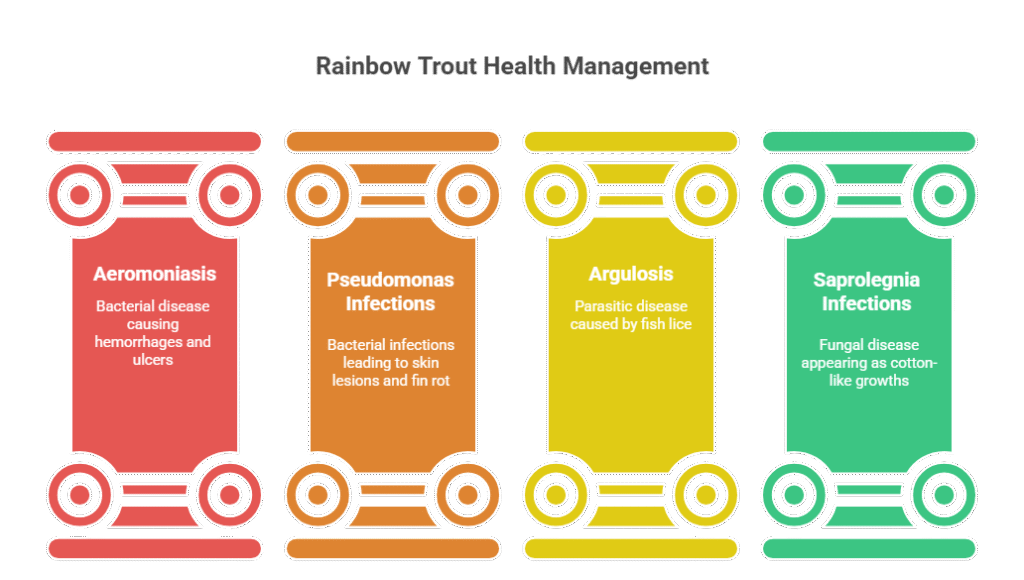
Argulosis (fish lice)
Argulosis, commonly known as fish lice, is a parasitic disease in rainbow trout caused by Argulus species, characterized by small, visible parasites attached to the skin and gills, leading to irritation, mucus secretion, skin lesions, reduced appetite, and slower growth, which can increase susceptibility to secondary infections.
Effective control includes maintaining good water quality, regular pond monitoring, and treating affected fish with anti-parasitic chemicals such as formalin at 250–300 mg per liter of water for 1 hour or potassium permanganate at 2–3 mg per liter, ensuring careful dosing and follow-up treatments as needed to fully eliminate the parasites while minimizing stress and toxicity to the fish.
Saprolegnia infections
Saprolegnia infections in rainbow trout are fungal diseases caused by Saprolegnia species, commonly appearing as white or gray cotton-like growths on the skin, fins, or gills, often following injuries, stress, or poor water quality, leading to tissue damage, lethargy, and increased mortality if untreated.
Management involves improving water quality, reducing stress, and treating affected fish with antifungal agents such as potassium permanganate at 2–3 mg per liter for 30–60 minutes or formalin at 15–25 mg per liter for 1 hour, ensuring careful dosing and repeated treatments if necessary, while removing severely infected fish to prevent the spread of the fungus in the pond.
Harvesting
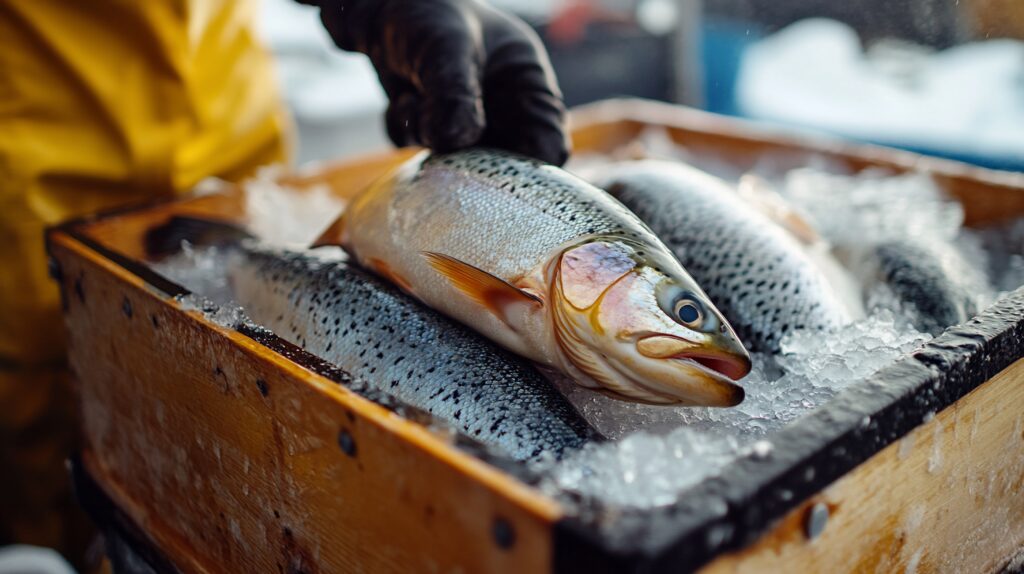
Rainbow trout are typically harvested after 6–8 months when they reach a size of 300–400 g, with partial harvesting often practiced to manage pond stocking density, and the fish are sold live, fresh, or iced to local markets, hotels, and tourist areas.
Capital Investment for Rainbow Trout
One-time costs per 0.1-hectare (1012 sq. meter) farm:
| Item | Cost (NPR) |
| Pond construction | 250,000 |
| Water supply system | 80,000 |
| Aerators & equipment | 50,000 |
| Miscellaneous tools | 20,000 |
| Total | 400,000 |
Operating Cost of Rainbow Trout
Annual recurring costs for 0.1-hectare (1012 sq. meter) farm:
| Item | Cost (NPR) |
| Fingerlings (10,000 @ 15 NRs) | 150,000 |
| Feed | 100,000 |
| Labor | 60,000 |
| Fertilizers & lime | 20,000 |
| Miscellaneous | 15,000 |
| Total | 345,000 |
Total Revenue from Rainbow Trout
| Parameter | Value |
| Production per 0.1 ha | 4,000 kg |
| Average market price | NPR 350/kg |
| Total Revenue | NPR 1,400,000 |
Analysis of Rainbow Trout Farming Profit
| Parameter | Amount (NPR) |
| Farm Size | 0.1 ha (1012 sq. meter) |
| Capital Investment (One-time) | 400,000 |
| Annual Operating Cost | 345,000 |
| Total Cost (Capital + Operating) | 745,000 |
| Total Revenue | 1,400,000 |
| Gross Profit | 1,400,000 − 345,000 = 1,055,000 |
| Net Profit (Total Revenue − Total Cost) | 1,400,000 − 745,000 = 655,000 |
| Return on Investment (ROI) | (Net Profit / Total Cost) × 100 = 87.9% |
SWOT Analysis of Rainbow Trout Farming
| Strengths | Weaknesses |
| High market demand and price | Requires cold water and technical knowledge |
| Short production cycle | High initial investment |
| Nutritional and export potential | Sensitive to disease and water quality |
| Opportunities | Threats |
| Expansion to eco-tourism areas | Climate change affecting water temp |
| Export to neighboring countries | Competition from imported fish |
| Value-added products (smoked fish) | Water pollution and natural disasters |
Sources
Augusty, K.T. 1979. Fish Farming in Nepal. Archana Printers & Publishers, Kottayam 29, India.
ICAR. 2006. Handbook of Fisheries and Aquaculture. Indian Council of Agricultural Research (ICAR), New Delhi.
Jha, D.K. 1991. Laboratory Manual of Fish Disease. Tribhuvan University, IAAS, Rampur.
Jhingran, V.G. and R.S.V. Pullin. 1985. A Hatchery Manual for the common, Chinease and Indian Major Carps. Asian Development Bank, ICLARM, Manila, Philippines.
NACA. 1989. Integrated Fish Farming in China Technical Manual 7. A World Food Day Publication of the Network of Aquaculture Centre in Asia and the Pacific, Bangkok Thailand.
Shrestha, M.K. and N.P. Pandit. 2012. A Text Book of Principles of Aquaculture (Second Edition). Aquaculture Department, Institute of Agriculture and Animal Science, Rampur, Chitwan, Nepal.
Shrestha T.K. and D.K. Jha. 1993. Introduction to Fish Culture. Institute of Agriculture and Animal Science, Rampur, Chitwan, Nepal.
Woynarovich, E. and L. Horvath. 1984. The Artificial Propagation of Warm Water Finfishes, A Manual for Extension.