Grey Leaf Spot (GLS) of Maize
Grey leaf spot of maize is among the most destructive foliar diseases, particularly in warm and humid agro-climatic regions where conditions favor rapid disease spread. The disease initially appears as small, pale lesions on the lower foliage and gradually develops into elongated, rectangular spots that range from grey to light brown. When infection becomes severe, the effective leaf area for photosynthesis is greatly reduced, resulting in weakened plant growth, poor kernel development, and considerable yield losses. Effective and timely management is therefore essential to protect maize productivity.
Causes
Grey leaf spot of maize is caused by the fungal pathogens Cercospora zeae-maydis and Cercospora zeina. These fungi persist mainly on infected maize residues that remain on the soil surface after harvest, serving as a primary source of infection for subsequent crops.
Symptoms
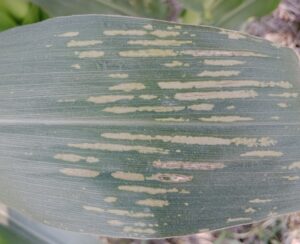
Early symptoms of GLS appear as small, yellowish spots on the lower leaves of maize plants. As the disease advances, these spots enlarge into long, narrow, rectangular lesions that are sharply restricted by leaf veins. The lesions gradually change color from light grey to tan, giving affected leaves a dull, ash-like appearance.
Under prolonged humid conditions, multiple lesions may merge, forming large necrotic areas. In severe cases, premature drying of leaves occurs, which significantly limits photosynthesis. This reduction directly affects grain filling, leading to poorly developed cobs and reduced yields.
Epidemiology
The development of grey leaf spot is strongly influenced by environmental conditions. High relative humidity (above 90%), frequent rainfall, extended leaf wetness, and moderate temperatures ranging from 22–30°C create ideal conditions for spore germination and infection.
The pathogen spreads through wind currents, rain splash, and irrigation water, allowing rapid dissemination across maize fields. Dense plant populations and limited air movement within the crop canopy increase humidity, intensifying disease severity. Continuous maize cultivation, particularly under conservation or minimum tillage systems, further increases disease risk by allowing infected residues to persist and act as a continuous source of inoculum.
Disease Cycle
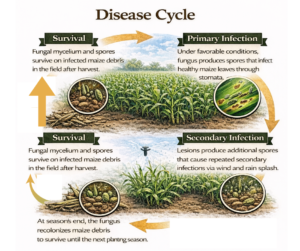
The GLS disease cycle begins with the survival of fungal mycelium and spores in infected maize debris left in the field after harvest. When favorable environmental conditions occur, the fungus produces spores that are carried to healthy leaves by wind and rain splash. Infection typically takes place through natural openings such as stomata. Once lesions develop, they produce additional spores that cause repeated secondary infections throughout the growing season. At the end of the crop cycle, the pathogen recolonizes maize residues, ensuring its survival until the next planting season.
Management
Effective management of grey leaf spot relies on an Integrated Disease Management (IDM) approach. This strategy combines resistant varieties, cultural practices that reduce pathogen survival, and judicious fungicide use. Regular crop scouting during periods of high humidity is crucial for early detection and timely intervention, helping to limit disease spread and minimize yield loss.
Cultural Management
- Rotate maize with non-host crops such as legumes or oilseeds.
- Destroy or deeply incorporate infected crop residues through ploughing.
- Maintain recommended plant spacing to improve air circulation.
- Avoid excessive nitrogen application, which can favor disease development.
Host Resistance
Growing maize hybrids with tolerance or resistance to grey leaf spot is one of the most effective and sustainable control measures. The use of certified, disease-free seed further reduces the risk of introducing the pathogen and supports healthy crop establishment.
Chemical Control
Fungicide application should be considered when GLS symptoms are observed on the third leaf below the tassel, as this timing helps protect the upper, most photosynthetically active leaves. Commonly recommended fungicides include triazoles such as Propiconazole 25 EC (1.0 ml/L water) and strobilurins like Azoxystrobin 23 SC (0.5 ml/L water).
Combination fungicides (e.g., Azoxystrobin + Tebuconazole) applied at 0.5–1.0 ml/L water provide broader and longer-lasting control. Sprays should ensure thorough leaf coverage, and label-recommended doses and intervals must be followed to prevent fungicide resistance.
Frequently Asked Questions (FAQs)
Q1. What is the most effective treatment for leaf spot diseases?
The most effective way to control leaf spot diseases is through an integrated management approach. This includes the use of fungicides, such as protectant products like Mancozeb (2–2.5 g/L of water) and systemic fungicides like Propiconazole (1 ml/L) or Azoxystrobin (0.5 ml/L), applied at the early stages of infection. Long-term control is further improved by cultivating resistant varieties, maintaining balanced fertilization, and conducting regular field monitoring to detect and manage the disease promptly.
Q2. When is the right time to spray for leaf spot?
Fungicide sprays should be applied as soon as initial symptoms appear, particularly on the lower leaves. In maize, spraying is most effective when lesions are seen on the third leaf below the tassel, as this protects the upper leaves that contribute most to grain filling. Applications should be made when foliage is dry, and repeat sprays may be required during prolonged humid conditions.
Q3. Is grey leaf spot a foliar disease?
Yes, grey leaf spot is a foliar disease that primarily affects maize leaves. Caused by Cercospora zeae-maydis and Cercospora zeina, it damages leaf tissue and interferes with normal photosynthesis. The disease progresses from small chlorotic spots to elongated grey or tan lesions, which may merge under favorable conditions. Severe infections result in reduced photosynthesis, early leaf senescence, poor cob development, and significant yield losses. As a foliar disease, GLS management focuses on protecting leaf health through cultural practices, resistant hybrids, and timely fungicide applications.