Chamomile Farming
Chamomile is a valuable aromatic and medicinal herb widely cultivated for its highly sought-after flowers, which are used in tea, essential oils, cosmetics, and various herbal remedies. Farmers primarily grow two species: German Chamomile (Matricaria chamomilla or Matricaria recutita), an annual plant known for its high flower yield, and Roman Chamomile (Chamaemelum nobile), a perennial variety valued for its fragrance and medicinal properties.
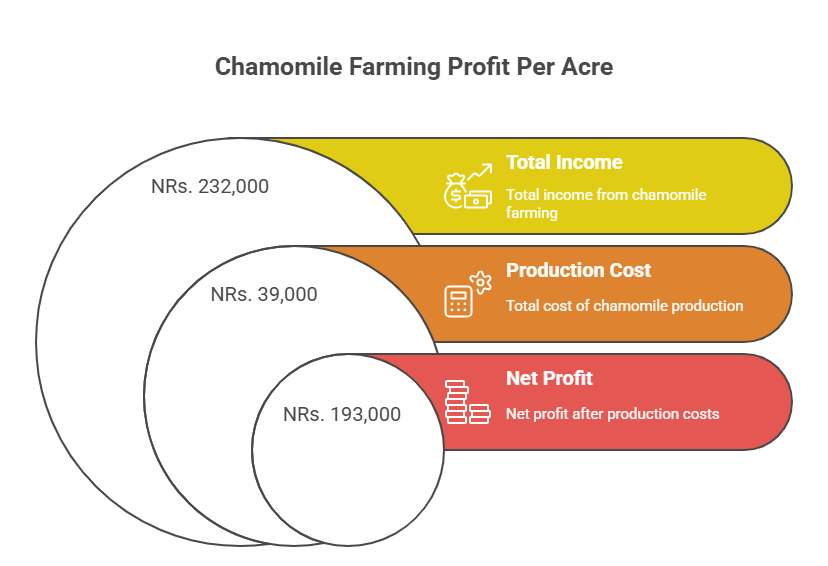
Chamomile farming is gaining attention as a profitable agricultural enterprise, largely due to the impressive chamomile farming profit per acre. With a total income of 232,000 NRs and a production cost of only 39,000 NRs, farmers can achieve a remarkable net profit of 193,000 NRs per acre. This outstanding return, reflected in a 495% profit margin and a Benefit–Cost Ratio of 5.94, means that every 1 rupee invested can yield nearly 6 rupees, making chamomile one of the most rewarding and sustainable medicinal crops to cultivate.
Land Preparation
Chamomile cultivation begins with thorough land preparation to ensure optimal growth. The field should be well-leveled and cleared of weeds and crop residues from the previous season. Primary tillage involves deep plowing of 20–25 cm using a moldboard plow to break compacted soil and enhance aeration.
This is followed by secondary tillage, where 2–3 harrowings or rotavations are performed to break soil clods and create a fine, friable seedbed essential for uniform germination and healthy root development. For improved drainage and easier crop management, raised beds can be formed, with properly designed drainage channels to prevent waterlogging and ensure the chamomile plants establish well.
Soil Type
Chamomile thrives best in well-drained sandy loam to loamy soils rich in organic matter, with a slightly acidic to neutral pH of 5.5–7.5. Good drainage is essential, as the plant is highly susceptible to root rot in waterlogged conditions, though it shows moderate tolerance to soil salinity.
Climatic Requirements
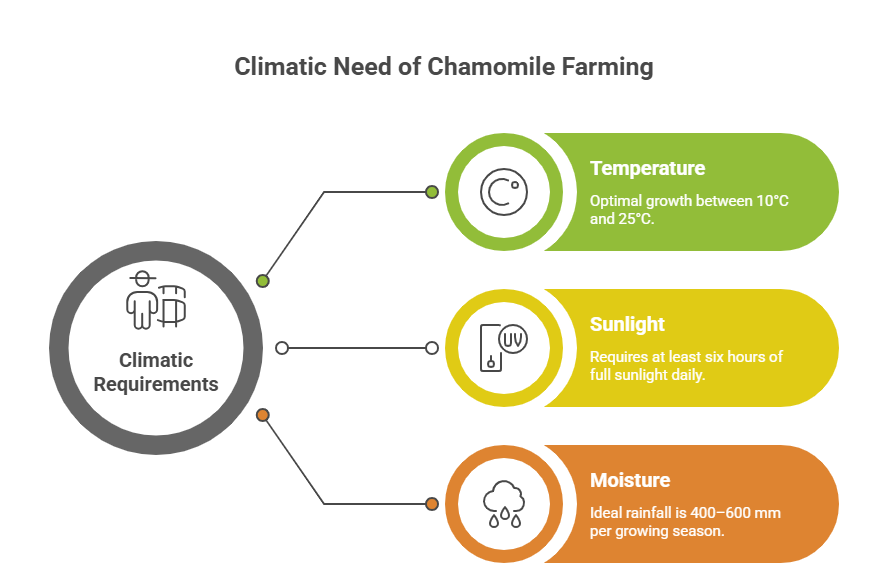
Chamomile thrives cool to moderate climates and is a hardy plant, growing optimally at temperatures between 10°C and 25°C, with seed germination possible above 7°C. It prefers full sunlight for at least six hours daily to ensure healthy growth and abundant flower production, though it can tolerate partial shade with reduced flowering. Moderate moisture is essential, with 400–600 mm of rainfall per growing season being ideal, while prolonged drought or excessive rainfall can negatively affect the crop.
Major Cultivars
| Aspect | Details |
| Standardization | No highly standardized cultivars like in major crops. Selections are primarily made for flower yield and essential oil content. |
| German Chamomile | Type: Annual Example Cultivars: ‘Bodegold’, ‘Degumille’, ‘Goral’, ‘Zloty Lan’, ‘Mammut’, ‘Bona’. Note: Local selections are also frequently used. |
| Roman Chamomile | Type: Perennial Example Cultivars: ‘Flore Pleno’ (double-flowered), ‘Treneague’ (non-flowering, used as a ground cover). |
| Seed Source | Farmers typically source “provenance seed” from reliable suppliers who specialize in medicinal plants. |
Propagation
Primarily done by seeds. Roman chamomile can also be propagated by root division or cuttings, but seed is most common for large-scale farming.
Seed Rate per Acre
The recommended seed rate for chamomile varies by planting method: direct seeding requires about 2.5 to 3.5 kg of seeds per acre due to the extremely small seed size (approximately 17,000 seeds per gram), while transplanting needs only 0.5 to 1.0 kg per acre for raising nursery seedlings.
Nursery Management (For Transplanting Method)
For nursery management in the transplanting method, prepare a fine, weed-free seedbed in a protected area, then mix chamomile seeds with fine sand for uniform broadcasting and sow them thinly on the surface, pressing lightly without covering since they require light for germination.
Water gently using a fine mist to keep the bed consistently moist without overwatering and expect germination within 7–14 days under optimal temperatures of 15–20°C. Seedlings become ready for transplanting in 4–6 weeks, once they reach 5–7 cm in height and develop 4–6 true leaves.
Planting
a). Planting Season
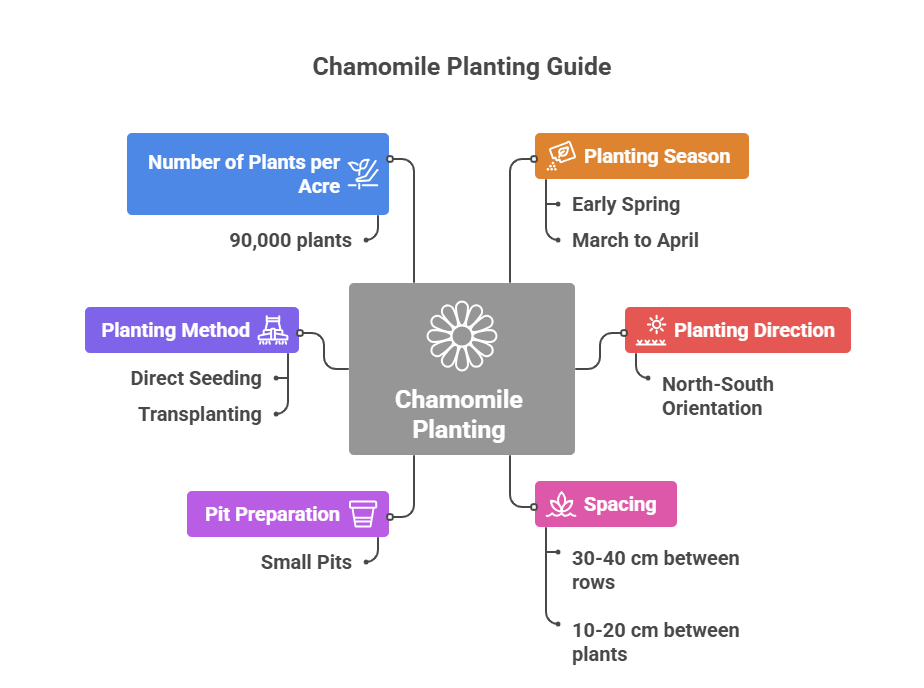
The spring crop of chamomile should be sown in early spring, typically during March to April, after the risk of the last frost has passed.
b). Planting Direction
Rows are typically oriented North-South to maximize sun exposure.
c). Spacing
Chamomile plants should be spaced 30 to 40 cm between rows and 10 to 20 cm between individual plants.
d). Pit Preparation
For transplanting, small pits are made at the desired spacing.
e). Planting Method
Chamomile can be planted either by direct seeding, where seeds are broadcast or drilled in rows with minimal raking—suitable for large, flat fields—or by transplanting, which is more common as it ensures better uniformity, optimal plant population, and reduces early weed competition, with seedlings typically transplanted in the evening or on a cloudy day.
f). Number of Plants per Acre
With a spacing of 30 cm x 15 cm, approximately 90,000 plants per acre.
Intercropping
Chamomile is well-suited for intercropping because of its low stature and short growing duration; it can be grown alongside slow-growing perennial crops during their initial years or as a catch crop between rows of taller plants, while avoiding crops that are highly competitive for water or create excessive shading.
Irrigation
Irrigation is crucial for chamomiles, especially during the flowering stage to ensure proper flower development; drip irrigation is ideal as it conserves water and keeps foliage dry, reducing disease risk, though sprinklers can also be used. Light and frequent irrigations are recommended, starting immediately after sowing or transplanting, followed by watering every 7–10 days in dry conditions, with reduced irrigation as the crop approaches harvest to prevent fungal problems.
Fertilizer and Manure
Chamomile is not a heavy feeder. Over-fertilization, especially with nitrogen, promotes lush foliage at the expense of flowers.
| Fertilizer/Amendment Type | Key Information | Specific Recommendation |
| Basal Dose (Organic) | Well-decomposed Farm Yard Manure (FYM) or compost | 8-10 tonnes per acre, incorporated during land preparation. |
| Biofertilizer | Azospirillum + PSB + Potash mobilizing bacteria | Apply 800g of each per acre (total 2.4 kg) before planting. |
| Inorganic Fertilizer (NPK) | General NPK ratio recommendation | 40:20:20 kg (N:P₂O₅:K₂O) per acre. |
| Application Schedule (NPK) | Basal Dose at Planting | Apply full P & K and half the N (i.e., full 20:20 kg P₂O₅:K₂O + 20 kg N). |
| Top Dressing | Apply the remaining half N (20 kg) 30-40 days after transplanting or during active vegetative growth. |
Weed Control
Weed control in chamomile is most critical during the first 30–45 days after planting or emergence. Mechanical methods, such as one to two shallow hand hoeings, are effective before the plants bush out and cover the ground. Chemical control can also be employed using pre-emergence herbicides like Pendimethalin, applied carefully, while consulting local agricultural experts to ensure the use of registered and safe herbicides suitable for medicinal crops.
Inter Culture Operation
The main intercultural operations are weeding and hoeing to aerate the soil. For perennial Roman chamomile, cutting back after flowering can encourage a second flush and maintain plant shape.
Flower Management
Chamomile begins flowering 6–8 weeks after sowing, with blooms continuing for 4–6 weeks. Effective flower management focuses on maximizing the number of flower heads, the crop’s economic product, by ensuring plants are healthy and receive balanced nutrition and adequate water during bud formation, while no specific fruit management is required.
Pest and Disease Management
Common Pests
a). Aphids
Aphids are small, soft-bodied insects that suck sap from tender shoots and leaves, causing stunted growth, yellowing, and distorted foliage. Infestations can be managed effectively using neem oil at a concentration of 2–3 ml per liter of water or insecticidal soap at 2–3% solution. Apply thoroughly on affected plant parts, especially the undersides of leaves, early in the morning or late in the evening to avoid harming pollinators. Repeat the application every 7–10 days if infestation persists.
b). Thrips
Thrips primarily attack flowers, leading to discoloration, scarring, and reduced quality of flower heads. They can be managed by placing yellow sticky traps around the crop to monitor and reduce adult populations. Additionally, botanical insecticides such as neem oil (2–3 ml/liter of water) or azadirachtin-based formulations can be sprayed carefully on affected flowers. Applications should be done in the early morning or late evening, and repeated at 7–10 day intervals if necessary.

Common Diseases
a). Damping Off
Damping off is a common disease affecting seedlings, caused by soil-borne fungi such as Pythium and Rhizoctonia. It leads to seedling collapse and poor germination. Prevention is crucial—ensure well-drained nursery beds, avoid overcrowding, and maintain proper hygiene. If necessary, treat seeds before sowing with a fungicide like Carbendazim at 2 g per kg of seed or Thiram at 3–4 g per kg of seed to reduce fungal infection.
b). Root Rot and Powdery Mildew
Root rot and powdery mildew are common in chamomiles due to waterlogging, poor soil drainage, or inadequate air circulation. Symptoms include wilting, root decay, or white powdery growth on leaves and stems. Prevention involves planting in well-drained soil, maintaining adequate spacing, and avoiding overhead irrigation late in the day.
In severe cases, fungicides can be applied: for powdery mildew, use Sulphur 0.2–0.3% solution or Wettable Sulphur 2–3 g/liter of water; for root rot, apply Carbendazim 0.1% or Captan 0.2% as a soil drench. Follow integrated pest management (IPM) practices and avoid repeated chemical use to maintain plant health and soil safety.
Harvesting
Harvesting chamomile is a labor-intensive and critical operation, best done when flower heads are fully open but not yet wilting or shedding petals, as this stage ensures the highest essential oil content. Harvesting should be carried out in the late morning on sunny, dry days, since oil content is reduced in wet or very humid conditions.
Flower heads are typically hand-picked along with a small portion of the stalk (2–3 cm), although mechanical harvesters can be used if flowering is uniform, keeping in mind they may damage flowers. Because flowers mature unevenly, harvesting is repeated every 7–10 days throughout the flowering period, usually totaling 5–7 pickings.
Yield
| Yield Type | Average Yield per Acre | Additional Notes / Context |
| Fresh Flower Yield | 1,500 to 2,500 kg per season | Primary harvest output; depends on cultivar, climate, and management practices. |
| Dry Flower Yield | 300 to 500 kg | Based on a drying ratio of approximately 5:1 (fresh to dry). |
| Essential Oil Yield | 4 to 8 kg of blue essential oil | Extracted from dry flowers, representing an oil yield of 0.2–0.4% from the dry flower weight. |
Cost of Production per acre for Chamomile
| S.N. | Categories | Cost (NRs.) |
| 1 | Land Preparation | 15,000 |
| 2 | Seed | 1,000 |
| 3 | Nursery Management | 2,000 |
| 4 | Transplanting | 1,000 |
| 5 | Fertilizers and Manure | 6,000 |
| 6 | Irrigation | 4,000 |
| 7 | Weed Control (Pre & Post-emergence) | 2,000 |
| 8 | Pest & Disease Control | 2,000 |
| 9 | Harvesting | 3,000 |
| 10 | Miscellaneous Costs | 3,000 |
| Total Cost of Cultivation | 39,000 |
Income per acre from Chamomile Farming
| Particulars | Estimated Yield (kg) | Market Price (NRs/kg) | Total Income (NRs.) |
| Dried Flower (per acre/year) | 400 | 580 | 232,000 |
Analysis of Chamomile Farming Profit Per Acre
The profit analysis of chamomile farming per acre shows that the total income is 232,000 NRs, while the total cost of cultivation is 39,000 NRs, resulting in a net profit of 193,000 NRs per acre. This gives a very high profit margin of 495% and a strong Benefit–Cost Ratio of 5.94, meaning that for every 1 rupee invested, a farmer earns 5.94 rupees in return.
Also Read: Stevia Farming Profit Per Acre
Sources
University of California Agriculture & Natural Resources (UC ANR)
European Plant Protection Organization (EPPO)
Punjab Agricultural University (PAU)
Tamil Nadu Agriculture University (TNAU) – Agritech portal
Indian Council of Agricultural Research (ICAR)
Nepal Agricultural Research Council (NARC)
U.S. Department of Agriculture (USDA).
Ministry of Agriculture and Livestock Development (Nepal)