Catfish Farming
Catfish farming is a highly profitable and fast-growing aquaculture enterprise, driven by the species’ rapid growth, strong market demand, resilience to harsh conditions, and high consumer preference. Maximizing catfish farming profit per acre requires a thorough understanding of the technical, biological, and economic aspects of catfish culture. This overview covers all key stages of production, from pond setup to detailed profit calculations.
The financial assessment of catfish farming indicates that catfish farming profit per acre is highly promising, with each production cycle generating a gross profit of NPR 1,050,000 (Total Revenue minus Operating Costs), providing consistent returns.
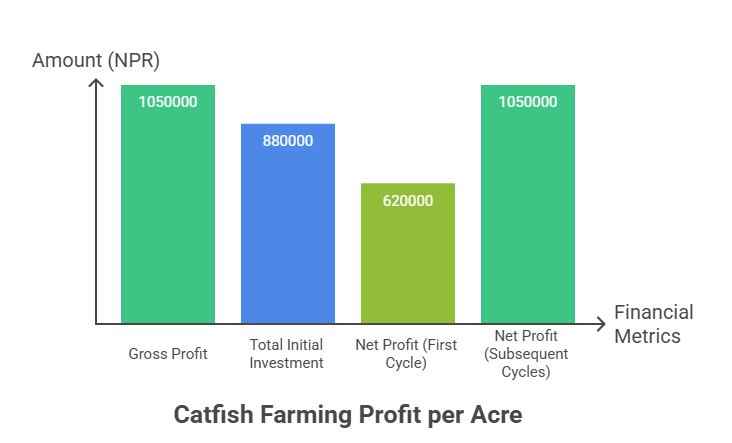
The total initial investment for the first cycle, encompassing both capital and operating expenses, amounts to NPR 880,000, resulting in a net profit of NPR 620,000 after accounting for setup costs. In subsequent cycles, net profit rises to NPR 1,050,000 per acre, as only recurring operating costs are incurred. The return on investment (ROI) for the first cycle is approximately 70.5%, reflecting efficient utilization of the initial capital, while the gross profit margin of 70% demonstrates a substantial proportion of revenue retained as profit.
Fish Farming
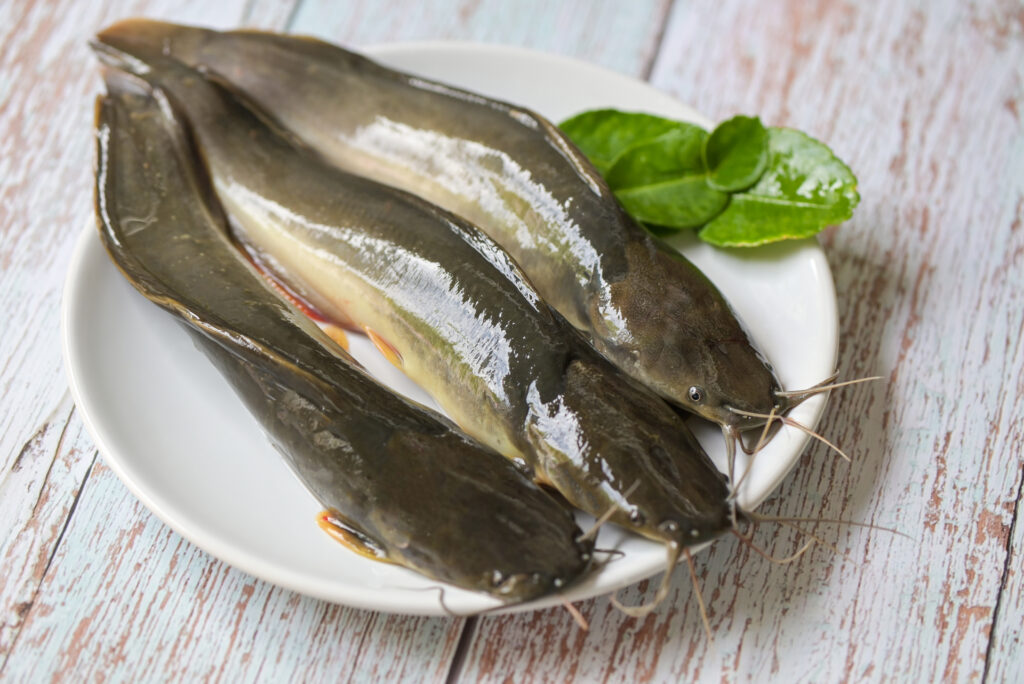
Catfish (Clarias gariepinus and Pangasius spp.) are hardy, air-breathing freshwater fish known for their adaptability and rapid weight gain. They can be raised in earthen ponds, cement tanks, cage systems, or biofloc units. Their ability to survive in low-oxygen waters makes them ideal for semi-intensive and intensive aquaculture systems. Profitability largely depends on seed quality, feed efficiency, management, and local market prices.
Farm Size and Production System
For commercial catfish farming, a 1-acre pond is generally considered the ideal standard unit for both financial planning and technical management, making it suitable for farmers of all scales. Catfish production typically follows one of three major farming systems—Extensive, Semi-intensive, and Intensive—each offering different levels of input and yield potential.
Among these, the Semi-intensive system is the most widely adopted because it strikes an optimal balance between investment, management effort, and economic return. This system ensures higher productivity than extensive farming while avoiding the high operational costs associated with intensive systems, allowing farmers to achieve a profitable yield of 4,000–6,000 kg per acre under proper management.
Pond Construction
A well-designed pond is essential for maximizing productivity and reducing fish mortality in catfish farming. Ideally, the pond should cover 1 acre (approximately 4,047 m²) with a water depth of 1.2–1.5 meters and dike height of 1.5–2 meters to prevent overflow during heavy rainfall.
Proper inlet and outlet systems made of PVC or HDPE pipes with protective screens are necessary to ensure controlled water flow, while maintaining a gentle 1–2% slope helps achieve efficient drainage. Clayey soil is the most suitable for pond construction because it naturally minimizes seepage, and all embankments should be thoroughly compacted to prevent erosion and leakage.
Pond Preparation
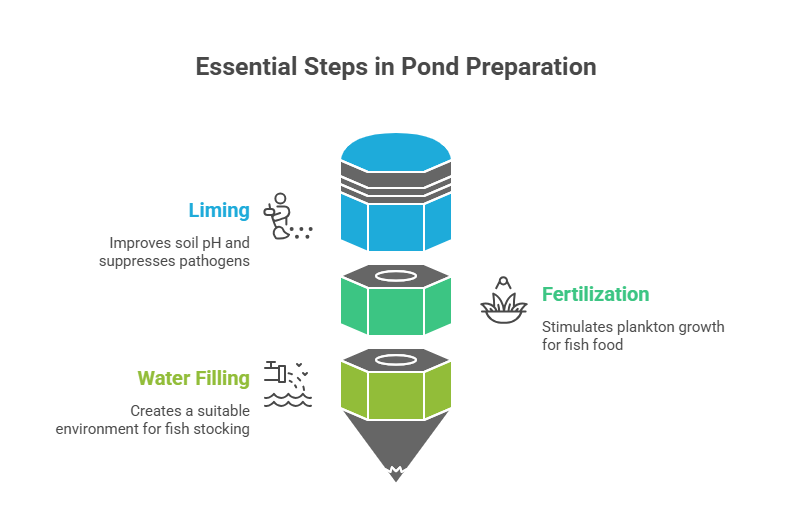
Liming
Liming is an important step in pond preparation as it helps improve soil pH, suppress harmful pathogens, and increase the overall effectiveness of fertilizers applied later. The recommended lime dosage is 200–300 kg per acre, depending on the acidity level of the soil, with higher doses required for more acidic conditions. For best results, the lime should be spread evenly across the entire pond bottom as well as the embankments, ensuring uniform pH correction and better pond soil health before water filling and stocking.
Fertilization
Fertilization is a crucial step in pond preparation as it stimulates the growth of natural fish food, particularly plankton, which supports healthier and faster fish growth.
Farmers typically apply 500–1,000 kg of cow dung per acre as an organic fertilizer to enrich the pond with essential nutrients, while also using inorganic fertilizers such as 8–10 kg of urea and 20–25 kg of Single Super Phosphate (SSP) per acre to further enhance plankton production.
The combination of organic and inorganic fertilizers creates a balanced nutrient environment, ensuring an adequate and continuous supply of natural food for the fish during the early stages of culture.
Water Filling
After completing the liming and fertilization process, the pond should be filled with clean water to a depth of about 3–4 feet, ensuring a suitable environment for fish stocking. Once filled, the pond must be allowed to stabilize for 7–10 days, during which time a natural plankton bloom develops as a result of the earlier fertilization. This plankton serves as a vital initial food source for fingerlings, helping to improve survival rates and support early growth once the fish are introduced.
Seed Selection
Selecting high-quality seed is one of the most important factors for achieving good growth and high survival rates in catfish farming. For a semi-intensive production system, the recommended stocking rate is 8,000–10,000 fingerlings per acre, ensuring optimal use of pond resources without overcrowding.
Fingerlings should ideally be 4–6 inches long, active, uniform in size, and completely free from any signs of disease or deformity. It is essential to purchase seed only from reliable and certified hatcheries to ensure genetic purity and better performance. Before releasing them into the pond, proper acclimatization—by gradually adjusting the fingerlings to the pond water temperature and quality—helps minimize stress and improve survival rates.
Feeding
Feeding is the most critical and costly component of catfish farming, accounting for approximately 60–70% of total production costs, and directly influences growth rates and profitability. Farmers typically use floating or sinking pellets with 28–35% protein, depending on the age and size of the fish.
The recommended feeding rate is 5–8% of body weight for young fingerlings and 2–3% for adult fish, administered 2–3 times daily to ensure continuous availability of nutrients. Feeding can be done manually along the pond edges or using automatic feeders for more efficient distribution. Proper and consistent feeding not only promotes rapid growth but also optimizes the Feed Conversion Ratio (FCR), which usually ranges from 1.2–1.5 in well-managed semi-intensive systems, enhancing overall farm profitability.
Water Quality Management
Maintaining healthy water quality is essential for ensuring rapid growth, high survival rates, and overall productivity in catfish farming. Key parameters to monitor include dissolved oxygen (>4 mg/L), pH (6.5–8.5), temperature (26–32°C), ammonia (<0.02 mg/L), and water transparency (30–40 cm). Keeping these parameters within the ideal range creates a stable and supportive environment for fish growth.
Effective water management practices include aerating the pond during early morning, avoiding overfeeding to prevent ammonia buildup, and performing partial water exchanges during hot months to maintain oxygen levels and water quality. Additionally, removing accumulated sludge from the pond bottom helps prevent disease outbreaks and supports a healthier ecosystem for the fish.
Health & Disease Management
Catfish are hardy but still susceptible to stress-related issues.
Ulcers
Ulcers typically appear as open sores on the skin and can reduce growth rates and increase mortality if left untreated. Effective management begins with preventive measures such as maintaining optimal water quality, avoiding overcrowding, and providing a balanced diet.
For treatment, affected fish can be medicated with oxytetracycline at 50 mg per kg of fish body weight mixed into feed for 7–10 days, ensuring all fish receive the full therapeutic dose.
In addition, applying potassium permanganate (KMnO₄) at 2–3 mg/L as a pond dip for 30 minutes can help reduce external bacterial load. Early detection and timely treatment are crucial to minimize economic losses and maintain overall pond health.
Fin rot
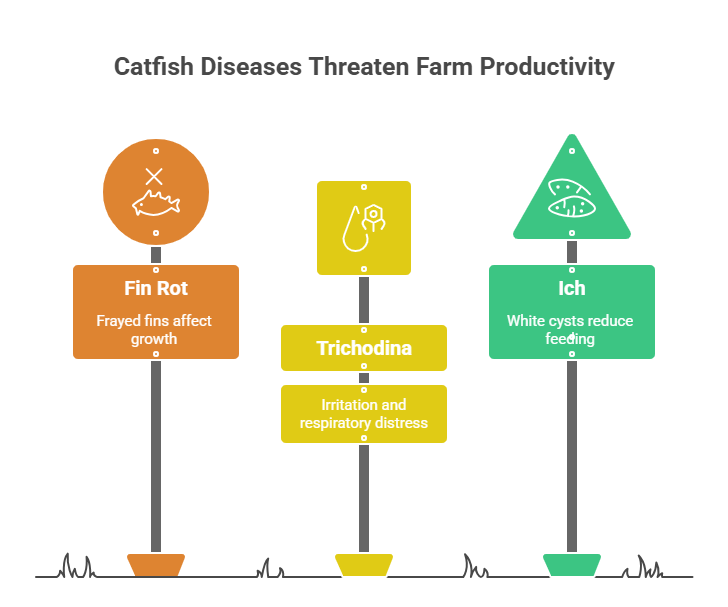
Fin rot is a common bacterial disease in catfish, often caused by poor water quality, overcrowding, or injury, leading to frayed or disintegrating fins that can affect growth and overall fish health. Prevention focuses on maintaining clean water, avoiding overcrowding, and minimizing stress.
For treatment, medicated feed containing oxytetracycline at 50 mg per kg of fish body weight administered for 7–10 days is effective, while improving pond hygiene and aeration helps reduce bacterial proliferation.
In severe cases, a potassium permanganate (KMnO₄) bath at 2–3 mg/L for 30 minutes can be applied to disinfect external surfaces and prevent further infection. Timely intervention ensures better recovery, reduces mortality, and supports higher survival rates in the pond.
Trichodina
Trichodina is a common parasitic infection in catfish that affects the skin and gills, causing irritation, excessive mucus production, and respiratory distress, which can reduce growth and increase mortality if left untreated. Prevention involves maintaining optimal water quality, avoiding overcrowding, and regularly cleaning the pond to reduce parasite load.
For treatment, affected fish can be exposed to a formalin bath at 250–300 mg/L for 30–60 minutes or treated with potassium permanganate (KMnO₄) at 2–3 mg/L in the pond, depending on severity, ensuring careful monitoring to prevent stress. Repeating the treatment after 3–5 days may be necessary for severe infestations. Early detection and proper management are critical for minimizing losses and maintaining healthy, productive fish.
Ich (White spot)
Ich (Ichthyophthirius multifiliis), also known as white spot disease, is a common parasitic infection in catfish that appears as tiny white cysts on the skin, fins, and gills, leading to irritation, reduced feeding, and increased mortality if untreated.
Prevention involves maintaining good water quality, avoiding sudden temperature fluctuations, and minimizing stress and overcrowding. For treatment, formalin at 250–300 mg/L or potassium permanganate (KMnO₄) at 2–3 mg/L can be applied in the pond, ensuring the fish are exposed for 30–60 minutes while monitoring oxygen levels closely.
In addition, malachite green at 0.2 mg/L can be used in severe cases, with treatments repeated every 3–5 days until all signs disappear. Prompt detection and proper management help protect fish health, reduce mortality, and maintain pond productivity.
Harvesting
Catfish typically reach a marketable size of 700 g to 1.2 kg within 6–8 months, after which harvesting can be carried out either partially using nets or completely by draining the pond. Farmers often sort fish by size before marketing, as market preferences influence harvest decisions, and larger-sized catfish generally command higher prices depending on local demand.
Capital Investment Per Acre for Catfish
Capital investment per acre for catfish farming generally includes typical one-time costs such as pond construction or renovation, water inlet and outlet structures, aeration equipment, and basic tools needed to set up a functional and efficient production system.
| Item | Cost (NPR) |
| Pond construction | 300,000 |
| Water inlet/outlet structures | 30,000 |
| Aerators (optional) | 80,000 |
| Tools & equipment | 20,000 |
| Total Capital Cost | 430,000 |
Operating Cost Per Cycle for Catfish Farming
| Item | Cost (NPR) |
| Fingerlings (10,000 nos.) | 40,000 |
| Feed (4–5 tons) | 300,000 |
| Fertilizers & lime | 10,000 |
| Labor | 50,000 |
| Medicines & probiotics | 10,000 |
| Electricity/aeration | 30,000 |
| Miscellaneous | 10,000 |
| Total Operating Cost | 450,000 |
Total Revenue per Acre from Catfish Farming
| Item | Details |
| Average Yield per Acre | 6,000 kg |
| Farm-Gate Price per kg | NPR 250 |
| Revenue Calculation | 6,000 kg × NPR 250 |
| Total Revenue | NPR 1,500,000 |
Analysis of Fish Farming Profit Per Acre
| Analysis Component | Calculation Formula | Result (in NPR) | Additional Note |
| Gross Profit per Cycle | Total Revenue − Operating Costs | 1,500,000 − 450,000 = 1,050,000 | Recurring profit from each cycle |
| Total Initial Investment (First Cycle) | Capital Investment + Operating Costs | 430,000 + 450,000 = 880,000 | First cycle startup cost |
| Net Profit (First Cycle) | Total Revenue − Total Initial Investment | 1,500,000 − 880,000 = 620,000 | Profit after setup costs |
| Net Profit from Subsequent Cycles | Total Revenue − Operating Costs | 1,500,000 − 450,000 = 1,050,000 | Profit from cycles 2 onward |
| Return on Investment (ROI) – First Cycle | (Net Profit ÷ Total Initial Investment) × 100 | (620,000 ÷ 880,000) × 100 = ≈70.5% | Efficiency of initial investment |
| Gross Profit Margin | (Gross Profit ÷ Total Revenue) × 100 | (1,050,000 ÷ 1,500,000) × 100 = 70% | Percentage of revenue kept as profit |
SWOT Analysis
Strengths
- Fast growth and high survival rate
- High market demand
- Suitable for small farmers
- Tolerant to poor water quality
- Profit within 6–8 months
Weaknesses
- Feed cost is high
- Diseases spread quickly in intensive systems
- Requires good water management
Opportunities
- Rising demand for quality protein
- Scope for value addition (fillets, smoked catfish)
- Export potential
- Integration with vegetables (aquaponics)
Threats
- Price fluctuations
- Water shortages in dry seasons
- Competition from imported fish
- Environmental concerns if waste is unmanaged
Sources
Augusty, K.T. 1979. Fish Farming in Nepal. Archana Printers & Publishers, Kottayam 29, India.
ICAR. 2006. Handbook of Fisheries and Aquaculture. Indian Council of Agricultural Research (ICAR), New Delhi.
Jha, D.K. 1991. Laboratory Manual of Fish Disease. Tribhuvan University, IAAS, Rampur.
Jhingran, V.G. and R.S.V. Pullin. 1985. A Hatchery Manual for the common, Chinease and Indian Major Carps. Asian Development Bank, ICLARM, Manila, Philippines.
NACA. 1989. Integrated Fish Farming in China Technical Manual 7. A World Food Day Publication of the Network of Aquaculture Centre in Asia and the Pacific, Bangkok Thailand.
Shrestha, M.K. and N.P. Pandit. 2012. A Text Book of Principles of Aquaculture (Second Edition). Aquaculture Department, Institute of Agriculture and Animal Science, Rampur, Chitwan, Nepal.
Shrestha T.K. and D.K. Jha. 1993. Introduction to Fish Culture. Institute of Agriculture and Animal Science, Rampur, Chitwan, Nepal.
Woynarovich, E. and L. Horvath. 1984. The Artificial Propagation of Warm Water Finfishes, A Manual for Extension.