Introduction
Alternaria blight of mustard is one of the most destructive fungal diseases affecting mustard cultivation, posing a serious threat to crop productivity and seed quality. The disease is particularly severe in warm and humid mustard-growing regions, where favorable environmental conditions allow the pathogen to spread rapidly and cause widespread infection. If not managed in a timely and integrated manner, alternaria blight of mustard can lead to extensive leaf damage, premature defoliation, poor pod development, and significant yield losses, making effective disease management essential for sustainable mustard production.
Causes
Alternaria leaf blight of mustard is caused by two closely related fungal pathogens, Alternaria brassicae, which is the most prevalent and destructive, and Alternaria brassicicola. These fungi primarily infect crops belonging to the Brassicaceae family and are capable of surviving for extended periods on infected crop residues, contaminated seeds, and alternative host plants, allowing the disease to persist and recur in mustard-growing regions year after year.
Symptoms
The disease affects leaves, stems, branches, flowers, and pods, with symptoms appearing at any crop stage, though severity increases after flowering.
Leaf Symptoms
On mustard leaves, the disease initially appears as small dark brown to black spots, particularly on older foliage. These spots enlarge rapidly and develop characteristic concentric rings, producing a distinct target board appearance. The lesions are commonly surrounded by a yellow halo, and under severe infection, the affected leaves gradually dry up, leading to premature defoliation.
Stem and Branch Symptoms
On stems and branches, Alternaria blight causes elongated dark brown to black lesions that may expand along the affected tissues. In severe infections, these lesions can girdle the stems or branches, weaken the plants and often resulting in lodging.
Pod (Siliqua) Symptoms
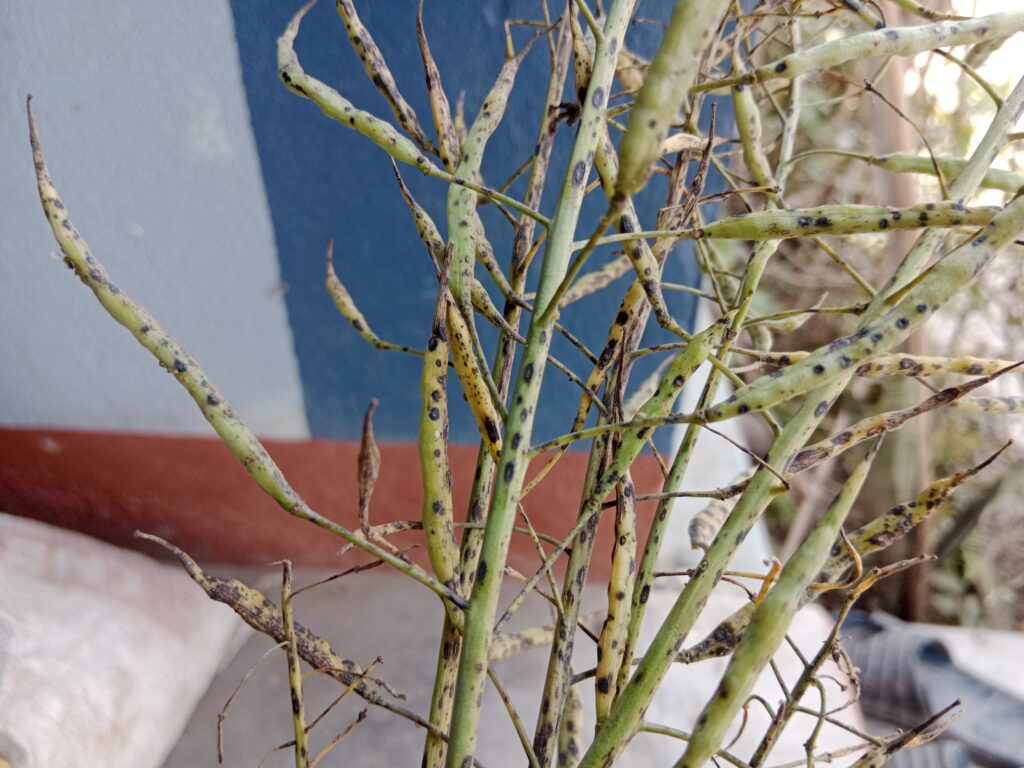
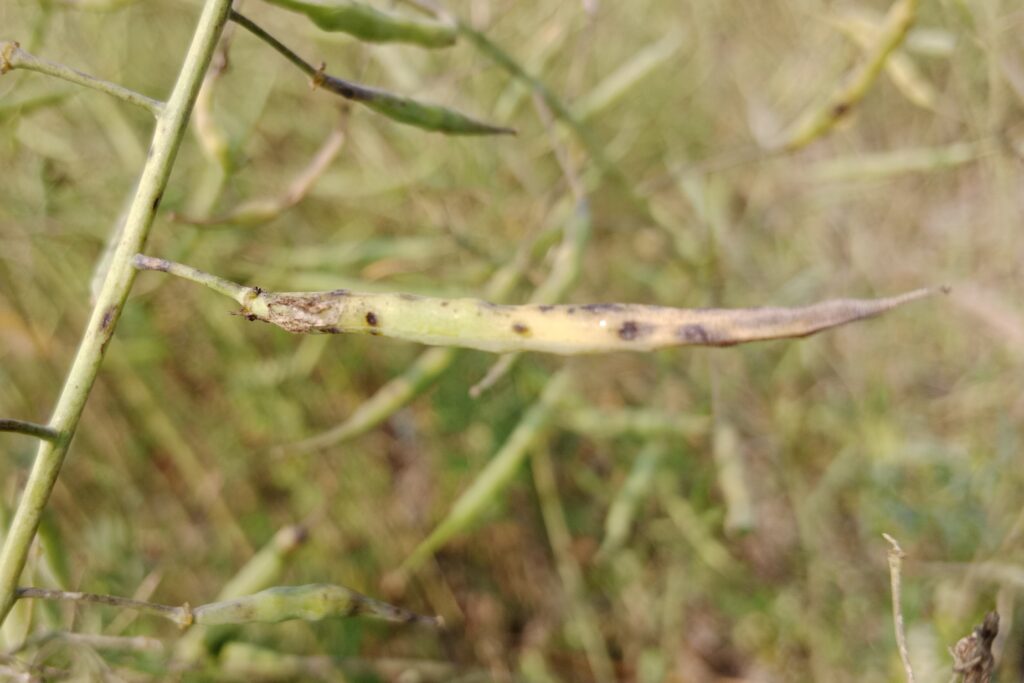
On the pods (siliquae), Alternaria blight manifests as circular to oval, sunken dark lesions that progressively enlarge. As the infection advances, the pods become shriveled, resulting in poor seed filling and a significant reduction in seed quality, while the infected seeds often appear discolored, lightweight, and shriveled.
Epidemiology
The epidemiology of Alternaria leaf blight of mustard is closely linked to environmental conditions that favor fungal growth and infection. The disease develops most rapidly within a temperature range of 18–30°C, particularly when relative humidity exceeds 70%. Prolonged periods of leaf wetness caused by dew, fog, or frequent rainfall create ideal conditions for spore germination and penetration.
Dense crop canopies further aggravate disease severity by trapping moisture and increasing humidity within the crop microclimate. Additionally, late-sown mustard crops are more susceptible due to their exposure to favorable weather conditions during critical growth stages. Overall, warm and humid weather accompanied by frequent rainfall during flowering and pod formation significantly enhances disease spread and intensity.
Disease Cycle
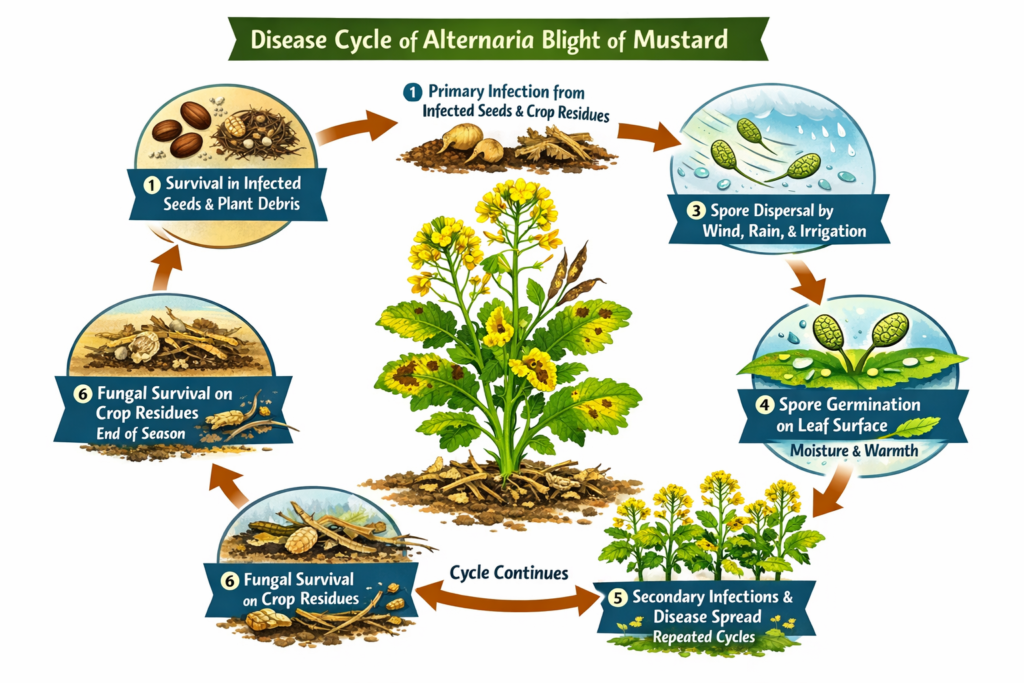
The disease cycle of Alternaria leaf blight begins with the survival of the pathogen as mycelium or spores in infected plant debris and seeds. Primary infection occurs when mustard plants emerge from infected seeds or come into contact with contaminated crop residues.
The fungal spores (conidia) are then disseminated through wind, rain splash, and irrigation water, where they germinate on leaf surfaces under favorable moisture and temperature conditions.
Secondary infections occur repeatedly throughout the growing season, facilitating rapid disease spread. At the end of the crop cycle, the fungus persists on remaining plant residues, thereby completing its life cycle and ensuring its carryover to the next season.
Management
An integrated disease management approach is most effective.
Cultural Practices
- Use disease-free certified seeds.
- Follow crop rotation with non-cruciferous crops for at least 2–3 years.
- Remove and destroy infected crop residues.
- Maintain optimum plant spacing to reduce canopy humidity.
- Avoid late sowing.
Resistant/Tolerant Varieties
Grow locally recommended tolerant mustard varieties, if available.
Seed Treatment
Effective management of Alternaria blight in mustard begins with seed treatment, which helps prevent the introduction of the pathogen into the field. Seeds should be treated with Carbendazim at 2 g/kg or a combination of Thiram and Carbendazim at 2.5 g/kg to protect against fungal infection.
In addition to chemical treatments, biological agents such as Trichoderma viride can be applied to the seeds as a natural, eco-friendly alternative, enhancing seedling health and reducing the initial disease inoculum. Proper seed treatment ensures healthy crop establishment and reduces the risk of Alternaria blight outbreaks during the growing season.
Chemical Control
Chemical control is a critical component of managing Alternaria blight in mustard and should be initiated at the first appearance of disease symptoms to effectively limit its spread. Recommended fungicides include Mancozeb 75 WP at 2–2.5 g/L, Chlorothalonil 75 WP at 2 g/L, and systemic fungicides such as Propiconazole or Difenoconazole at 0.5 ml/L.
To maintain protection throughout the vulnerable stages of crop growth, fungicide applications should be repeated at intervals of 10–15 days, with the frequency adjusted according to disease pressure and environmental conditions. Timely and judicious use of fungicides significantly reduces lesion development, preserves leaf area, and ensures better pod formation and seed quality.
Biological Control
Biological control offers an eco-friendly approach to managing Alternaria blight in mustard, particularly under moderate disease conditions. Foliar application of beneficial microorganisms such as Trichoderma or Pseudomonas fluorescens can suppress pathogen development, reduce lesion formation, and enhance the plant’s natural defense mechanisms, thereby helping to lower disease severity and support healthier crop growth.
FAQs
Q1. Is tebuconazole used for Alternaria?
Yes, Tebuconazole is widely used for managing Alternaria blight of mustard as a systemic fungicide that provides both protective and curative action. The recommended dose for foliar application is typically 0.5 ml of Tebuconazole 25 EC per liter of water (or as per the label instructions of the specific formulation).
Spraying should be done at the first appearance of symptoms or when environmental conditions favor disease development, and can be repeated at 10–15 day intervals depending on disease pressure. This treatment effectively reduces lesion formation, slows disease progression, and helps maintain healthy foliage and optimum crop yield.
Q2. How do you treat Alternaria blight of mustard?
Alternaria blight of mustard can be effectively managed through an integrated approach combining chemical, biological, and cultural practices. For chemical control, foliar sprays of Mancozeb 75 WP at 2–2.5 g/L, Chlorothalonil 75 WP at 2 g/L, Propiconazole 25 EC at 0.5 ml/L, or Tebuconazole 25 EC at 0.5 ml/L are recommended, applied at the first appearance of symptoms and repeated every 10–15 days depending on disease pressure.
Biological ageants such as Trichoderma or Pseudomonas fluorescens can be applied as foliar sprays under moderate conditions to reduce disease severity. Additionally, using disease-free seeds, seed treatment with Carbendazim (2 g/kg) or Thiram + Carbendazim (2.5 g/kg), proper crop rotation, and maintaining adequate plant spacing further help prevent disease establishment and ensure healthy crop growth.
Q3. What is the best fungicide for mustard?
The best fungicide for mustard depends on the target disease, but for Alternaria blight, systemic fungicides like Tebuconazole 25 EC or Propiconazole 25 EC are highly effective, as they provide both protective and curative action.
For broader protection, Mancozeb 75 WP or Chlorothalonil 75 WP can be used as contact fungicides. Foliar sprays should be applied at the first appearance of symptoms and repeated every 10–15 days based on disease pressure to ensure healthy foliage, reduce lesion development, and maintain optimum yield.