
Major insect pest of rice in India
Yellow Stem Borers
Rice stem borers are among the most destructive insect pests of rice, causing 10–30% yield loss under normal infestation and up to 60% or more during severe outbreaks. Damage is more serious when infestation occurs at early crop stages.
Caused by
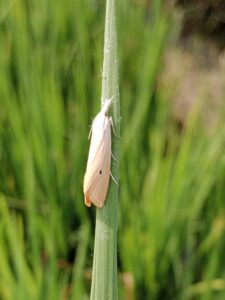
Yellow stem borer caused by Scirpophaga incertulas – most common and destructive.
Symptoms
Damage symptoms vary with crop growth stage:
Vegetative Stage
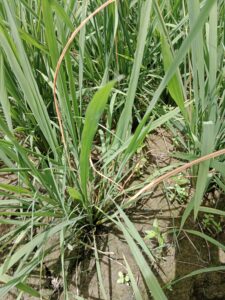
During the vegetative stage of rice, stem borer infestation leads to the formation of dead heart, in which the central leaf dries up, turns brown, and can be easily pulled out from the tiller, while the affected tillers fail to develop panicles, resulting in a direct reduction in productive tiller number and overall yield.
Reproductive Stage
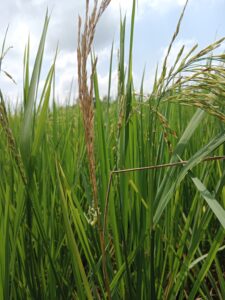
During the reproductive stage of rice, stem borer attack results in the formation of white ear or white head, where panicles emerge but remain empty, pale, and whitish due to the destruction of internal tissues, leading to complete failure of grain formation and causing direct and significant yield loss.
Additional signs
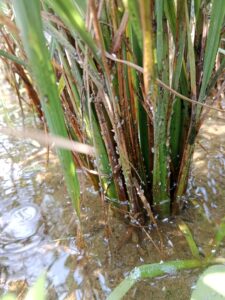
Additional signs of rice stem borer infestation include small entry holes at the base of the tillers, often visible near the waterline, along with the presence of frass (insect excreta) inside the stems, indicating active larval feeding within the plant tissues.
Management
Chemical control for rice stem borer should be initiated at the economic threshold level (ETL) when infestation reaches 5% dead heart during the vegetative stage, or when monitoring records show one moth per light trap per night, or when two egg masses per square meter are observed in the field, as timely intervention at this stage helps prevent significant yield loss.
Insecticides should be applied only after the crop crosses the economic threshold level (ETL), and for effective chemical management of rice stem borer, any one of the recommended insecticides—Chlorantraniliprole 18.5 SC at 150 ml per hectare, Flubendiamide 39.35 SC at 60 ml per hectare, or Cartap Hydrochloride 50 SP at 1 kg per hectare—may be used, ensuring proper dilution and uniform field coverage to achieve optimum control while minimizing unnecessary pesticide use.
Brown Planthopper (BPH)
Brown planthopper is one of the most destructive sucking pests of rice and can cause 10–70% yield loss, while severe outbreaks may result in complete crop failure due to rapid plant drying and hopper burn. It also acts as a vector of serious viral diseases.
Caused by
BPH infestation is caused by the sap-sucking activity of both nymphs and adults of Nilaparvata lugens. The pest multiplies rapidly under high nitrogen fertilization, dense planting, and humid, warm conditions.
Symptoms
- Yellowing and wilting of plants starting from leaf tips
- Hopper burn: brown, scorched patches in circular or irregular areas
- Stunted plant growth and reduced tillering
- Drying and lodging of plants in severe infestation
- Presence of large numbers of hoppers at the base of rice hills
- Transmission of grassy stunt and ragged stunt viral diseases
Management
Chemical control of brown planthopper should be initiated at the economic threshold level (ETL), which occurs when the population reaches 10–20 BPH per hill during the vegetative stage, 20–25 BPH per hill at the reproductive stage, or when hopper burn symptoms start appearing in the field. Timely intervention at this stage is crucial to prevent significant yield losses.
Insecticides should be applied only after the ETL is crossed, and rotation of chemical groups is recommended to avoid resistance. For effective control, any one of the following insecticides may be used: Buprofezin 25 SC at 800 ml/ha, Imidacloprid 17.8 SL at 100–125 ml/ha, Thiamethoxam 25 WG at 100 g/ha, Pymetrozine 50 WG at 300 g/ha, or Dinotefuran 20 SG at 150 g/ha, ensuring sprays are targeted toward the base of the plants where hoppers typically gather.
Green Leafhopper (GLH)
Green leafhopper is a sap-sucking insect and a major pest of rice, capable of causing 10–50% yield loss under severe infestation. Yield reduction occurs due to direct feeding damage and the transmission of viral diseases like rice tungro virus, which can devastate crops if not managed timely.
Caused by
GLH infestation is caused by nymphs and adults that feed on rice phloem sap. The pest multiplies rapidly in dense, nitrogen-rich crops and favor warm, humid conditions common in South and Southeast Asia.
Symptoms
- Yellowing and curling of leaves, often starting at the tip and margins
- Stunted growth due to nutrient depletion
- Presence of hopperburn in severe cases
- GLH acts as a vector of tungro virus, causing orange-yellow discoloration in leaves and reduction in tillering
- Nymphs and adults are usually found on the underside of leaves
Management
Management of green leafhopper involves avoiding excessive nitrogen fertilization to reduce pest proliferation and using light or yellow sticky traps to monitor and capture adult insects, helping to prevent population buildup and potential crop damage.
Chemical control of green leafhopper should be considered at the economic threshold level (ETL), which occurs when the population reaches 10–15 GLH per hill during the vegetative stage, 20–25 GLH per hill at the reproductive stage, or when signs of hopperburn or stunted growth begin to appear in the field, as timely intervention helps prevent significant yield loss.
Insecticides for green leafhopper should be applied only after the population crosses the ETL, with rotation of chemical groups to prevent resistance; recommended options include Buprofezin 25 SC at 800 ml/ha, Imidacloprid 17.8 SL at 100–125 ml/ha, Thiamethoxam 25 WG at 100 g/ha, or Pymetrozine 50 WG at 300 g/ha, ensuring that sprays are directed toward the underside of leaves, where nymphs and adults primarily feed.
Rice Leaf Folder
Rice leaf folder is a significant defoliator of rice, capable of causing 10–20% yield loss under moderate infestation and up to 50% or more in severe cases. Yield reduction occurs due to reduced photosynthetic area and weakened plant vigor.
Caused by
Leaf folder damage is caused by larvae of the moth Cnaphalocrocis medinalis, which feed on leaf tissue. The pest multiplies rapidly in dense, lush crops, especially under high nitrogen fertilization and humid, warm weather.
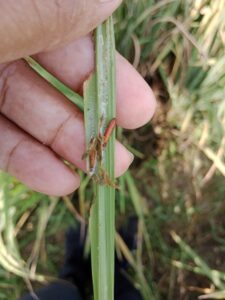
Symptoms
- Leaves are folded longitudinally and larvae feed inside the folds
- Presence of transparent window-like patches on leaves where tissue has been consumed
- Reduced leaf area, leading to stunted growth and delayed maturity
- Small black frass (insect excreta) inside the folded leaves
- Severe infestations may cause yellowing and drying of leaves, reducing overall yield
Management
Management of rice leaf folders includes avoiding excessive nitrogen fertilization to reduce pest proliferation and handpicking and destroying rolled leaves in small fields to physically remove larvae and minimize damage.
Chemical control of rice leaf folder is recommended at the economic threshold level (ETL) when 5–10% of leaves are rolled by larvae or when 2–3 larvae per plant are observed during the vegetative and early reproductive stages, as timely intervention helps prevent significant yield loss.
Insecticides for rice leaf folder should be applied only after the pest population crosses the ETL, with rotation of chemical groups to prevent resistance; recommended options include Chlorantraniliprole 18.5 SC at 150 ml/ha, Flubendiamide 39.35 SC at 60 ml/ha, or Quinalphos 25 EC at 1 L/ha, ensuring that sprays are directed toward the rolled leaves, where larvae hide and feed.
Rice Hispa
Rice hispa is a serious leaf-feeding pest that can cause 10–30% yield loss, depending on the severity of infestation. Severe attacks reduce photosynthetic area, stunt plant growth, and may lead to delayed maturity.
Caused by
Rice hispa damage is caused by adult beetles and larvae of Dicladispa armigera. Adults scrape leaf surface (creating characteristic white streaks), while larvae bore into leaf tissue. The pest thrives in high-density, nitrogen-rich rice fields and humid, warm conditions.
Symptoms
- Scraping of leaf surface by adults, forming white longitudinal streaks
- Leaf mining by larvae, leaving pale, translucent tunnels
- Yellowing and drying of leaves in severe infestation
- Reduced tillering and stunted growth
- Presence of adult beetles on leaf surfaces
Management
Management of rice hispa involves cultural and mechanical practices to reduce pest buildup, and chemical control is recommended at the economic threshold level (ETL) when 10% of leaves are damaged by scraping or mining or when 5–10 adult beetles per hill are observed, allowing timely intervention to prevent significant yield loss.
Insecticides for rice hispa should be applied only after the pest population crosses the ETL, with rotation of chemical groups to prevent resistance; recommended options include Carbaryl 50 WP at 1–1.5 kg/ha, Quinalphos 25 EC at 1 L/ha, or Thiamethoxam 25 WG at 100 g/ha, ensuring that sprays are directed toward both the leaf surface and edges, where adults feed and lay eggs.
Gall Midge (Orseolia oryzae)
Rice gall midge is a serious pest in rice-growing regions, causing up to 20–80% yield loss depending on the severity of infestation and susceptibility of the rice variety. Yield reduction occurs because infested tillers fail to produce panicles.
Caused by
Gall midge infestation is caused by larvae of the midge Orseolia oryzae, which feed internally on the shoot meristem, inducing abnormal growth (galls). The pest thrives in warm, humid conditions, dense planting, and high nitrogen-fertilized fields.
Symptoms
- Formation of silver shoots or “silver shoots gall”, which are short, swollen, and do not produce panicles
- Infested tillers appear thin, whitish, or yellowish
- Multiple shoots may emerge from a single node (excess tillering) but remain sterile
- Presence of tiny maggots inside the shoot
- Stunted growth and reduced tiller productivity
Management
Cultural Practices
Management of rice gall midge includes maintaining optimal spacing to reduce pest buildup and removing and destroying infested tillers during the early stages to prevent further spread and minimize yield loss.
Chemical control of rice gall midge is recommended at the economic threshold level (ETL) when 5–10% of tillers are infested during the early vegetative stages or when silver shoots are visible in the field, as timely intervention helps prevent significant yield loss.
Insecticides for rice gall midge should be applied only after the population crosses the ETL, with rotation of chemical groups to prevent resistance; recommended options include Carbofuran 3G at 25–30 kg/ha (soil application), Fipronil 5 SC at 1–1.5 L/ha, or Thiamethoxam 25 WG at 100 g/ha, ensuring that sprays are directed toward the base of the plants to target newly hatched larvae inside the shoots.
Rice Gundhi Bug
Rice gundhi bug is a serious sucking pest, especially during the late vegetative and reproductive stages, causing 10–25% yield loss under moderate infestation and up to 50% in severe outbreaks. The pest damages grains, resulting in shriveled, discolored, and empty seeds, which directly reduces both yield and grain quality.
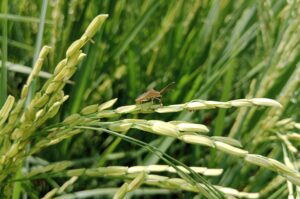
Caused by
Gundhi bug damage is caused by adults and nymphs of Leptocorisa species, which feed on developing grains by sucking sap from the spikelets. High-density plantings and late-stage rice crops under warm and humid conditions favor pest multiplication.
Symptoms
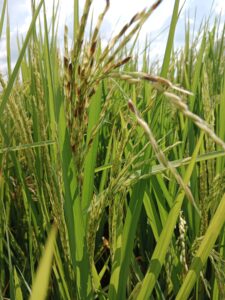
- Discolored grains: grains become whitish, shriveled, or empty
- Spikelet drying and partial sterility
- Presence of adults and nymphs along the neck of panicles
- Reduced grain filling and poor seed quality
- Aggregation of bugs near the base of panicles during morning and evening
Management
Chemical control of rice gundhi bug is recommended at the economic threshold level (ETL) when 10–15% of panicles are infested or when 5–10 bugs per hill are observed during the grain-filling stage, as timely intervention helps prevent significant yield and grain quality losses.
Insecticides for rice gundhi bug should be applied only after the population crosses the ETL, with rotation of chemical groups to prevent resistance; recommended options include Imidacloprid 17.8 SL at 100–125 ml/ha, Thiamethoxam 25 WG at 100 g/ha, or Carbofuran 3G at 25 kg/ha, ensuring that sprays are directed toward the base of panicles, where bugs congregate for feeding.
Rice Thrips
Rice thrips are minor yet important pests of rice, causing 5–15% yield loss under moderate infestation and 20–25% in severe cases, especially in nursery and early vegetative stages. Yield reduction occurs due to leaf damage, reduced photosynthetic area, and stunted growth.
Caused by
Thrips damage is caused by tiny, sap-sucking insects, both nymphs and adults, that feed on young leaves and seedlings. The pest thrives in warm, dry, and dusty conditions and is more prevalent in early transplanted or late-season crops.
Symptoms
- Silvery or whitish streaks on young leaves due to sap-sucking
- Leaves may appear curling, twisted, or dried at tips in severe infestations
- Stunted seedlings and reduced tillering
- Presence of tiny, slender insects on the underside of leaves
- Severe infestations may cause seedling mortality in nurseries
Management
Management of rice thrips involves cultural practices to reduce pest buildup, and chemical control is recommended at the economic threshold level (ETL) when 10–15 thrips per seedling or young plant in nurseries are observed or when significant silvering or stunting appears in the field, allowing timely intervention to prevent yield loss.
Insecticides for rice thrips should be applied only after the population crosses the ETL, with rotation of chemical groups to prevent resistance; recommended options include Imidacloprid 17.8 SL at 50–100 ml/ha, Thiamethoxam 25 WG at 50–75 g/ha, or Fipronil 5 SC at 1 L/ha, ensuring that sprays are directed toward young leaves and seedlings, where thrips aggregate and feed.
Rice Caseworm
Rice caseworm is a serious leaf-feeding pest, particularly in nursery and transplanted rice, causing 10–30% yield loss in moderate infestations and up to 50% in severe outbreaks. Yield reduction occurs due to damage to leaves, reduced photosynthesis, and delayed crop growth.
Caused by
Caseworm damage is caused by the larvae of the moth Nymphula depunctalis, which feed on leaf tissues while living inside protective silken cases. The pest multiplies rapidly in stagnant or waterlogged fields with abundant weed growth and high nitrogen levels.
Symptoms
- Leaves are chewed irregularly, often with ragged edges
- Presence of silken cases attached to leaves, containing larvae
- Yellowing and drying of leaves in severe infestations
- Reduced tillering and delayed panicle emergence
- Larvae are usually observed within the silken cases, feeding protected from natural enemies
Management
Chemical control of rice caseworm is recommended at the economic threshold level (ETL) when 5–10% of leaves are infested with larvae or silken cases or when severe leaf damage becomes visible in the field, allowing timely intervention to prevent significant yield loss.
Insecticides for rice caseworm should be applied only after the population crosses the ETL, with rotation of chemical groups to prevent resistance; recommended options include Quinalphos 25 EC at 1 L/ha, Carbofuran 3G at 25–30 kg/ha (soil application), or Chlorantraniliprole 18.5 SC at 150 ml/ha, ensuring that sprays are directed toward leaves with silken cases, where larvae are protected and actively feeding.
Rice Mealybug
Rice mealybug is a sap-sucking pest that can cause 10–25% yield loss under moderate infestation and up to 40% in severe cases, primarily by weakening the plant, reducing tillering, and affecting grain formation.
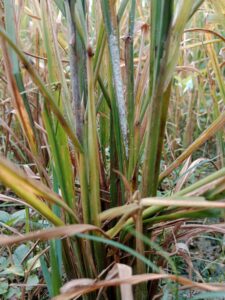
Caused by
Damage is caused by adults and nymphs of Brevennia rehi, which suck sap from leaves, stems, and nodes. The pest thrives in highly humid conditions, dense planting, and fields with excessive nitrogen fertilization.
Symptoms
- Leaves turn yellow or pale and may exhibit curling
- Stunted growth and reduced tillering
- White, waxy mealy masses on leaf surfaces, stems, and nodes
- Presence of honeydew and sooty mold on affected parts
- In severe cases, plants may dry prematurely and fail to produce panicles
Management
Chemical control of rice mealybug is recommended at the economic threshold level (ETL) when 5–10% of plants are infested or when visible waxy white colonies and leaf yellowing are observed, allowing timely intervention to prevent significant yield loss.
Insecticides for rice mealybug should be applied only after the population crosses the ETL, with rotation of chemical groups to prevent resistance; recommended options include Imidacloprid 17.8 SL at 50–100 ml/ha, Thiamethoxam 25 WG at 50–75 g/ha, or Quinalphos 25 EC at 1 L/ha, ensuring that sprays are directed toward leaf surfaces, stems, and nodes, where mealybugs aggregate and feed.
ALSO READ: Major Diseases of Rice and Their Control
Sources
Food and Agriculture Organization (FAO)
University of California Agriculture & Natural Resources (UC ANR)
European Plant Protection Organization (EPPO)
Tamil Nadu Agriculture University (TNAU) – Agritech portal
Indian Council of Agricultural Research (ICAR)
Nepal Agricultural Research Council (NARC)
U.S. Department of Agriculture (USDA).
Ministry of Agriculture and Livestock Development (Nepal)
Pingback: Rice Growth Stages Explained -